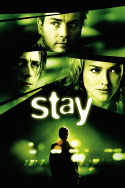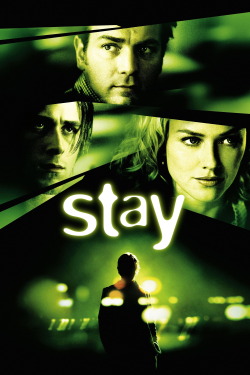
Review of Stay (2005) by Matthew P — 29 Nov 2010
Here I was, thinking I was going to understand Stay. I noticed early on in the film that there were subtle techniques used in the transition from scene to scene. I thought that was going to play a key role in understanding the film. It should have played an important part, but instead, didn't. That's not to say that it isn't important as a filming technique. In fact, it is interesting just by itself. The thing is, Stay made me think I was smarter than I was, and that is something I almost wish I could take to the grave.
I won't though, as I have already let that secret out of the bag. I tell the story in the opening with purpose; do not make the same mistake I did. Do not think that you are smarter than this film, just because you caught the subtle technique used in its creation. Why don't you want to do that? Well, it's because you will focus too heavily on that, and miss the other imagery used within it. Not seeing this, and like me, you'll end up misunderstanding what the film is about.
After being completely shown up by Stay, I couldn't get it out of my head. I was confused, and yet still fascinated by it. I needed to watch it again, this time looking for other key symbols within it. After doing this, I found myself surprised by how much I had missed the first time, and how completely off-base I was in my initial reaction to it.
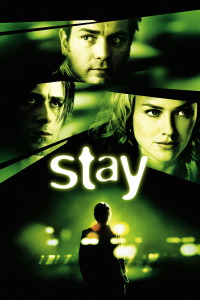
The film assaults you with so many things, often skewing what you initially believed to be true. The main character in this picture, or at least, the one we follow the most, is Sam (Ewan McGregor). He's a psychiatrist, and has been tasked with taking the suicidal patient Henry (Ryan Gosling). Henry has decided that he is going to kill himself on Saturday at midnight. He makes no bones about this; he's an artist. We are told that the greatest work of art is a perfectly planned and executed suicide, a work of art that Henry would like to accomplish.
It seems, however, that Henry doesn't actually want to go through with this, telling Sam that he is the only one that can help him. Sam's girlfriend (Naomi Watts) did go through a suicide attempt herself, so what better way to get help than find a person who deals with this kind of thing on a daily basis? However, Henry doesn't seem to like Sam all that much, avoiding him for the majority of the day, and only showing up when it is most convenient.
The plot is heavy in details, ones which are almost all important. As I mentioned earlier, there are many images and symbols used throughout the film, which, like the plot, are all important in some degree or another. A good film has everything occurring for a reason, while a bad one has unnecessary or redundant details. Stay falls into the former category, with every detail mattering.
Let's look at, for example, the filming technique used at the beginning. If that is what you focus on, you will miss everything else. You can't forget about the way the film transitions from one shot to another though, or you will not see an important part. This is a good example of what I am talking about. Everything is important, and there is almost too much to take in during one viewing.
This ends up being the film's sole problem. It might be too confusing and overloaded to be enjoyed only giving it one chance. In fact, some might not like it at all, due to not understanding it, and might wish to push it out of their mind for good. I, on the other hand, felt the complete opposite. I wanted to know more about Stay, and what it was trying to accomplish. It was an incredibly intriguing experience, and I wasn't quite sure what to make of it.
I was aware that the acting was quite good, particularly with the actors in the leading roles. McGregor and Gosling were excellent in portraying their characters. We don't get to know all that much about them, at least, not at the beginning, so being played in a mysterious way works well.
My only other complaint about the film is the fact that we don't have much reason to care about the characters involved. None of the characters really give us much reason to care for them, and instead they are used just to tell the story of the film. We can't project ourselves onto them either, like some blank protagonists, and instead are left with nothing. Even if Sam fails, and Henry does commit suicide, will we really care?
After watching Stay for the first time, I couldn't get it out of my head. I couldn't get by without understanding it. "Getting" the film is something that I had to do, so I actually ended up watching Stay twice. I ended up enjoying it quite a bit both times, despite the first time ending in the film showing me up. The subtle transition between scenes it uses is strange at first, and it's a technique that I likely focused on too heavily on my first viewing. The acting was good, and while the story was very plot heavy, the confusing aspect to it made it something you'll want to watch again.
This review of Stay (2005) was written by Matthew P on 29 Nov 2010.
Stay has generally received positive reviews.
Was this review helpful?