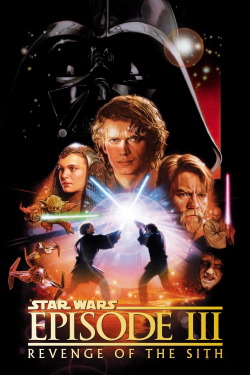
Review of Star Wars: Episode III - Revenge of the Sith (2005) by John W — 20 Apr 2016
At this point you'd probably be surprised to hear that this Star Wars films was by a fair margin the only Star Wars film to come close to the original in terms of initial reviews from critics. Getting glowing feedback whilst all the prior follow-ups would initially faced more mixed results which it seems like many would be hesitant to admit.
I didn't want to talk about each film with regards to how I think their characters fit into what we see in the OT, but will here as it is where we have their transitions into their forms from those films by and large.
Anakin is the most obvious. We see how his fall started (in TPM we are introduced to his initial cockiness and his fear of change/loss) and progressed (in AOTC we see his conflicted feelings towards the Jedi Order and having to deal with the death of somebody he cares about) but now finally see his actual turn to the Dark Side. But also his seduction pertaining to wanting to cheat death fits in poignantly with his redemption in ROTJ where it is through a willing self-sacrifice he saves his soul. It is interesting to compare his own death scene with Shmi's in AOTC in a piece of mirroring that I've never really seen talked about. In both cases the Skywalker parent is held in the arms of their child who is doing their best to try and reassure them that they can save them. Whilst in different ways the parent talks about how they are proud to see what their son has become and at the end of the day feels complete through that. Basically, when looking at the story chronologically and read between the lines we see that Anakin has finally come to understand what his mother said. At the end of the day it all accumulates to Anakin realizing that one's being is more important than physical life and the ultimate satisfaction in leaving behind something great in your children.
Obi-Wan's character is perhaps the most underrated of the iconic ones if that makes any sense. Or rather, his true complexity within the entirety of the saga never feels fuly appreciated. I think I'd argue the best example that defines him is encapsulated in his confrontation with Anakin on Mustafar. In TPM we saw a young man who was arrogant and aloof. One who was all about completing the mission in contrast to his master who took a more compassionate approach with those he came across. And that's best shown there when Anakin starts raving about his "New Empire" but Obi-Wan's first instinct now is to check to see if Padme is okay. In the middle of their duel Obi-Wan finally manages to admit his failure. The impetus for the man we see he's become in ANH who approaches teaching Luke differently than he did his father. Adopting an approach closer to Qui-Gon's. But what's more this film in a roundabout kind of way also highlights his flaws in those films as well. Namely given how eerily similar his relationship with Luke is to Palpatine and Anakin's. Both at those times being one of the last members of an overthrown order of Force users in hiding, stations himself in the up-and-coming Skywalker's life with the hope that he can one day help him defeat his enemies, and manages to present himself as a more understanding and supportive mentor/father-figure in contrast to his official surrogate father who he is frustrated with because he feels he is holding him back. (In Luke's case it is his uncle Owen, but ironically enough in Anakin's it was Obi-Wan himself) But the more important and tellings ones are how both have a habit of twisting around the truth (regardless of whether or not would consider it outright lyincg) to steer the Skywalker in the direction he needs, in Obi-Wan's case it was basically to manipulate a young man into unwittingly killing his father, and when questioned on certain shady points defend themselves specifically with the "Point of View" card.
This review of Star Wars: Episode III - Revenge of the Sith (2005) was written by John W on 20 Apr 2016.
Star Wars: Episode III - Revenge of the Sith has generally received positive reviews.
Was this review helpful?