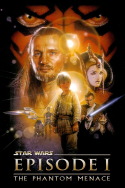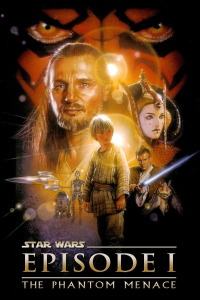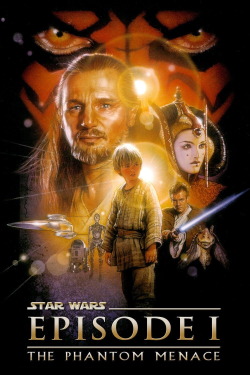
Review of Star Wars: Episode I - The Phantom Menace (1999) by Oliver H — 03 Mar 2016
As a child of the nineties, 'The Phantom Menace' was my first venture into George Lucas's globally revered 'Star Wars' universe, and what a remarkable discovery it was. On second thoughts, the word 'remarkable' doesn't do justice to my experience, because love it or hate it, 'The Phantom Menace' changed by whole world forever. As the setup of a new trilogy of movies that would explore the origins of the franchise's original (and most famous) villain, Darth Vader, 'Episode I' has its fair share of problems. Make no mistake, this is a heavily flawed movie, but I believe that those who feel compelled to rip it to shreds and accuse it of being inferior to the originals may have missed the point entirely. The movie's purpose was not to live up to the high standards of the original trilogy, which realistically speaking, it never had a chance of doing, but rather to introduce a brand new generation of viewers (like myself) into to the wonders of 'Star Wars.' It's a long shot from perfection, but despite some less than compelling execution, 'The Phantom Menace' still succeeds in its goals, and remains of my favourite childhood movies of all time.
One of the most regretful aspects of the movie was its inability to match fan expectations. Many fans were clamoring for another masterpiece of the likes of 'A New Hope' or 'The Empire Strikes Back', but that was never George Lucas's intention. By his own admission, Lucas is neither very good at writing or directing, and in the original trilogy, had the smarts to hire professional collaborators to help bring his visions to life for the second and third installments. If there's one major issue at the centre of 'The Phantom Menace', it was Lucas's over ambition. And yet, while I may criticise it here, I also find it admirable. Here is a man with a creative vision, and regardless of what others may think, has the willingness and the patience (and the money!) to bring it to life the way he always meant it to. The finished product was always going to be a flawed one, so if this review sounds slightly apologetic, it's probably because I can understand why it failed in so many areas. But with a movie like this, there's no use in focusing on the negatives. This is a movie that is, by definition, inferior to the original 'Star Wars', but still admirable in its own right. The first line of Roger Ebert's review for 'The Phantom Menace' is still an inspiration to me: 'If it were the first 'Star Wars' movie, 'The Phantom Menace' would be hailed as a visionary breakthrough.' Ebert's fascination and positivity towards the 'Star Wars' movies matches my own, and it's through his words that I felt compelled to explore the more positive aspects of the movie in my review. In an age of cynicism, let's not forget to celebrate the good that comes from movies, even if they're as flawed as 'The Phantom Menace.'.
If you're the kind of cinemagoer who prefers to obsess over story and character, then you're inevitably not going to get a positive experience out of 'The Phantom Menace.' But if you're like me, and are able to forgive some less than compelling plotting and characterisation and appreciate the fantastical escapist nature of the film, then there's plenty to enjoy here. It's a shame that the characters introduced here aren't as iconic or memorable as those we came to know in the original trilogy. There's no lovable rogue like Han Solo or relatable protagonist like Luke Skywalker, and the closest thing we get to Chewbacca is a digitally created character called Jar Jar Binks, a comedic character who ends up being more of an irritation than an amusement, but I'm not going to ferociously criticise the movie just because the characters are a bit bland.
The acting talents of Liam Neeson and Ewan McGregor are unforgivably wasted, however, particularly in the case of the latter. Neeson plays Qui-Gon Jinn, the wise mentor figure occupied by Sir Alec Guinness in the original trilogy, but we never learn anything about Qui-Gon's life or backstory, and more concerning, he appears to be missing a personality. Lucas seems to insist that emotionless stoicism be the default setting for the Jedi, but it doesn't make for very compelling screen presences. Similarly, McGregor, who plays the younger version of Guinness's Obi-Wan Kenobi, is unjustifiably back seated throughout the picture, and is occasionally permitted to utter bland lines of dialogue to remind audiences that he hasn't completely vanished. I feel Mr. Lucas made a vital mistake in this area; ideally, the movie should have focused on Obi-Wan, a character whom we've already been introduced to and would like to know more about, and we would gradually watch him grow and develop into the more mature and wiser Alec Guinness type we first met in 'A New Hope' over the course of the three movies. Obi-Wan's lack of screen presence was a wasted opportunity, especially when considering the potential that McGregor had in the role, and what's worse is that we never witness the earliest days of the relationship between Obi-Wan and the adolescent Anakin Skywalker, i.e. the whole purpose of the prequel trilogy.
On the subject of Anakin, Jake Lloyd (who portrays the ten-year-old version of Darth Vader) doesn't actually appear until approximately halfway through the movie, and isn't treated with the expected seriousness as much as a convenient device to help advance the plot. Much like his son-to-be, Luke Skywalker, Anakin was raised in poverty on the desert planet of Tatooine, but lacks the relatable nature of his offspring, and Lucas has deliberately gone out of his way to highlight Anakin's alleged importance in the greater narrative. We're constantly reminded that Anakin is the 'chosen one', one of the oldest clichés in fantasy storytelling, and that it's Anakin's destiny to 'bring balance to the Force', whatever that's supposed to mean. Vader is undoubtedly a very important part of Star Wars lore, and undoubtedly the most famous (or infamous) screen antagonists of all time, but Anakin is simultaneously overcooked and underdeveloped. We're told of Anakin's great destiny and immense importance, but in terms of fleshing out the character, there's nothing here. Lucas doesn't seem as interested in developing his characters as reminding us of why they're important, and it's a shame the franchise's creator doesn't take as much interest in his own characters as the fans. The closest we get to actual development is Anakin's infatuation with Padme (Natalie Portman), a fourteen-year-old handmaiden to Queen Amidala who's sole purpose in the movie can be traced to the love story that will flourish in the subsequent two installments.
While it may fail on the narrative front, 'The Phantom Menace' is nothing short of a triumph when it comes to world building and pure fantastical escapism. Until now, the only version of the Star Wars galaxy we've witnessed is that ruled by the dreaded Empire. Now we find ourselves thrust back in time, to around thirty years before the Empire casts its bleak shadow across the countless star systems, and all involved have done an exceptional job of fleshing out this treasured universe in a way never seen before. Just like the original movie, 'The Phantom Menace' was a milestone in demonstrating the possibilities generated by digital effects, and proved once again that anything that could be imagined could now be realised. These days, we take such astonishing computerised creations for granted, but back in '99, these kinds of visual effects were revolutionary, and it's a shame we can no longer appreciate or be as awestruck by them as we once were.
Equally stunning is John Williams' soundtrack, who returns to compose the fourth entry in the saga following his timeless work on the original trilogy, to provide one of the most groundbreaking orchestral soundtracks of all time. 'Duel of the Fates', which plays during the climactic lightsaber battle between Qui-Gon, Obi-Wan and Darth Maul will likely go down in history as one of the most iconic pieces of 'battle music' ever to grace cinema, and 'Anakin's Theme' is similarly beautiful in a much gentler and more symphonic way, even offering slight hints of Vader's theme, a subtle piece of musical foreshadowing that is unlikely to be missed by keen eared fans.
As aforementioned, 'The Phantom Menace' may be a failure on a narrative level, and its inability to connect to me on an emotional level as well as Lucas's poor attempts at character depth are what really let this installment down. While it's unlikely that you'll remember any of the characters or the dialogue once the credits finish rolling, the waterfalls of Naboo and the towering skyscrapers of Coruscant are far more likely to remain in your mind's eye, and if nothing else, 'Episode I' does a decent job of reintroducing the Star Wars universe to a new generation of fans. As many long-term fans have already cited, 'The Phantom Menace' is best viewed as an extended prologue to the subsequent installments, and is one I would recommend mainly as a gateway movie for younger audiences wishing to become invested in the Star Wars story for the first time. It's mostly spectacle over substance, but the impressive world building, technical achievements (by 1999 standards, anyway) and escapist nature of the film all make the official 'first' episode in the Star Wars saga one worth investigating, even if it pales in comparison to the original three pictures.
This review of Star Wars: Episode I - The Phantom Menace (1999) was written by Oliver H on 03 Mar 2016.
Star Wars: Episode I - The Phantom Menace has generally received mixed reviews.
Was this review helpful?