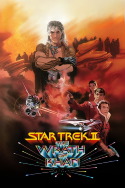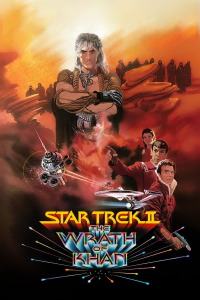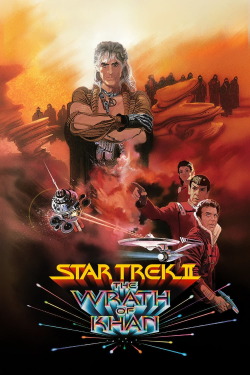
Review of Star Trek II: The Wrath of Khan (1982) by Cameron J — 19 Aug 2013
Well, it would appear as though Ricardo Montalbán really has escaped from the Planet of the Apes, and now he's out for revenge, which is cool, I guess, even though I just can't get over how miscast he is in this film's title role. Jeez, as much of a commercial success as this "Star Trek" series is, you know that they were going to try and keep it contemporary, but in the 1980s, I never would have guessed that they would go so far as to make a film in which the Enterprise go up against Chaka Khan. I reckon that explains why this film boasts such heavy themes about emotions and humanity and whatnot, because if Spock is to take on the head dog of Rufus, then he better renounce his Vulcan oath against human emotions and really pump up some soul, mm-hm. Hey, the joke premise is still not too much dumber than the actual premise to "A Voyage Home", but it is still one ridiculous stretch, because where the Enterprise has clearly gotten by as bigger clusters of stars than the ones they're exploring, even without their Khan, Rufus knew that it was time to shut things down when their Khan bailed out, because, seriously, do you think that the band was "really" run by Kevin Murphy? Shoot, you kids nowadays probably don't even know who Chaka Khan is, let alone Rufus, because you didn't even remember Kirstie Alley until she rolled her fat set out of bed and onto "Dancing with the Stars", even though, as this film will tell you, she danced with the stars a long time ago, and it apparently burned off a whole lot more weight. Yeah, yeah, it's great and all that she lost, like, a thousand pounds (No, seriously, I was figuring she was a bout 1302 lbs. or something before the weight "loss"), but she's still not what she used to be, and if Bibi Besch is the one who gave Allen some food tips, I reckon that puts a much more literal spin on the famous line, "Can I cook or can't I?". You'd get it if you saw this film, which I would indeed recommend that you see, because it is pretty good, partially because it's not really about the Enterprise trying to save Earth by offering the alien attackers humpback whales they traveled to the past and San Francisco to acquire-I mean, by taking on Chaka Khan (Hey, that's a pretty catchy rhyme), even though it's still not without other issues.
At a fair deal shy of two hours, this film is shorter than its overblown predecessor, the 2.25-hour-long "Star Trek: The Motion Picture", so much so that I would argue that this film is pretty tight on its own, with limited fat around the edges to cause a sense of excess, which still doesn't completely dissipated, due to slow spells in atmospheric momentum, which are never dry to the point of being dull, or even all that terribly bland, but nevertheless retard pacing enough for you to get too much of a feel for this film's relatively tight, but still somewhat hefty length. The film doesn't run too long, but it doesn't always run too smoothly, livening up at times and limping at other times, and doing so in a fashion that's not always organic, resulting in a certain inconsistency in pacing that proves to be detrimental to engagement value, perhaps as much as other uneven areas. I would say that the film's uneven moments are moderate enough to be somewhat easy to deny, but not entirely, because in tone the film leaps between fluffiness and intense meat somewhat jarring, and when it comes to focus, storytelling will occasionally abandon a certain plot aspect for the sake of another. The film's narrative isn't all that firmly controlled when it comes to tone and focus, but it's at least consistent in conventionalism, an even greater strength which may still not be considerable, but dilutes the final product with a predictability that reflects the effort's biggest problems: the ones that rest in concept, alone. There's more weight to this installment in the "Star Trek" saga than there usually is, at least at this time, but there's still only so much of it, and only so many strengths to obscure such natural shortcomings, which, in all fairness, stand to be more emphasized by hiccups in the execution of an improvable concept, but still stand as hard to deny. If nothing else is wrong with this film, it is natural shortcomings, and while that's certainly not a huge issue, it limits the potential of this film, and does so with a little help from unevenness in pacing, tone and focus, until the final product is left with only so much offer. Still, what is offered through this film is enough to make a final product that is almost surprisingly rewarding, but not without the help of predictable strengths, such as those of a musical nature.
By 1982, James Horner had not yet established himself as one of the great modern score composers, so a whole lot of weight was placed on the shoulders of the then-up-and-comer to deliver, thus he does, turning in efforts that are sometimes unevenly used in this film, and not quite as sharp as Horner's future efforts, but still boast some then-unique and still-potent tastes which are both entertaining on their own, as well as complimentary to the capturing of this film, which is further brought to life by outstanding production designs by Joseph R. Jennings, whose subtly intricate tastes immerse, as well as dazzle, much like visual effects that have, of course, dated a bit over the years, but were strong at the time and remain fairly impressive to this day, being both neatly well-conceived and convincing enough to liven things up and help in drawing you into this world. The film excels technically and stylistically, so much so that it may very well outdo the style of "Star Trek: The Motion Picture", and if you think that sounds entirely good, well, you might want to slow down a bit, because this film's predecessor, while decent, focused on too much style at the expense of substance, so by being more technically sharp, this film holds a greater risk of collapsing into a style-over-substance situation, which, of course, makes the level of substance to this "Star Trek" saga installment all the more commendable. Even in concept, there's a certain dramatic and thematic weight to this sci-fi flick's story boasts a good deal of potential, but there's also plenty of thin areas that leave the film to run just as great of a risk of collapse into underwhelmingness, which goes more than narrowly avoided, largely thanks to a script by Harve Bennett and Jack B. Sowards, as well as the uncredited Nicholas Meyer and Samuel A. Peeples, that offers anything from decent dialogue to tasteful punch to depth, anchored by characterization that is thoughtful enough to fight through limitations in background information and sell you on the characters and their story, not unlike the performers. I suppose Ricardo Montalbán stands out with his subtly effective intensity as a betrayed-feeling man who is presented with the opportunity to exact vengeance, but most of the members of this colorful and iconic cast deliver to some extent or another, at least on a distinct charisma and chemistry that bring obviously memorable characters to life as kind of compelling. The onscreen talents do their jobs reasonably well, adding some life to this relatively more human sci-fi flick of a pretty high profile, but what might bring this film's compellingness to life the most is the offscreen performances, whose impressiveness doesn't end with writing strengths. What truly secures the reward value of this effort is the efforts of Nicholas Meyer, as the "credited" director, for although Meyer's storytelling has its slow and somewhat uneven moments, stylistic choices such as airtight framing immerse you into the environment, particularly during minimalist, but tense action sequences, while clever atmosphere control sharply meditates upon the wit of the film in order to sustain some degree of consistent entertainment value, the brood of the film's atmosphere in order to deliver on some haunting intensity at times, and, of course, the film's dramatic depth, resulting in a resonance and selling of such weighty thematic themes as life and companionship that was rarely seen on this level out of the "Star Trek" saga at this time, and ends up carrying this film something of a long way. I suppose the conclusion of this film, while somewhat forced in, is the most emotionally impacting, but there's an unexpected compellingness throughout the final product, whose shortcomings, both natural and consequential, are too considerable for reward value to be all that high, but cannot overshadow the strengths that make this flick one worthy of being seen by sci-fi fans and somewhat demanding moviegoers alike.
When the wrath has passed, slow spells and a smidge of inconsistency in tone and focus emphasize the natural thinness in this story concept that is enough for the final product to fall short of all that strong, but not so short that strong score work, immersive production value, impressive and reasonably well-aged visual effects, clever writing, charismatic performances and inspired direction, courtesy of Nicholas Meyer, aren't enough to carry "Star Trek II: The Wrath of Khan" high enough to stand as an almost surprisingly compelling and ultimately rewarding second installment in the cinematic branch of an iconic franchise.
3/5 - Good.
This review of Star Trek II: The Wrath of Khan (1982) was written by Cameron J on 19 Aug 2013.
Star Trek II: The Wrath of Khan has generally received very positive reviews.
Was this review helpful?