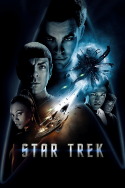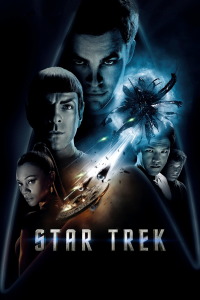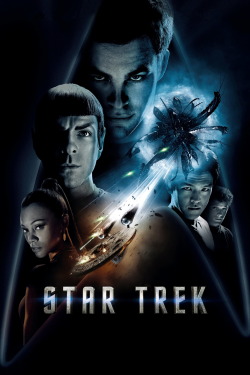
Review of Star Trek (2009) by Aaron G — 15 Jul 2016
Basically a reboot of the franchise in the same way as (good) Batman Begins, or (so-so) Casino Royale.
First, let me make my position clear: I've never been a Trekkie, but have seen a lot of the recent films and did watch both Voyager and Enterprise while they were still on TV. My dad, on the other hand (also not a Trekkie), remembers watching the original Star Trek and the older movies rather than the newer ones. Enterprise, by all accounts, was a bit of a flop as was the most recent Trek movie prior to this: Nemesis (which featured the Next Gen crew). JJ Abrams, who directs the new movie (and also MI-III as well as the likes of Lost, Buffy and Firefly on TV), has also admitted to never actually liking Star Trek, so it was a bit of a challenge to see if he could make a movie that would appeal to members of the audience like himself as well as to the hard-core Trekkies.
How has he done this? At its most basic, he's utilised the old time-travel/alternate reality paradox to create a new version of events; a new 'history' of the Federation, if you will. This has also allowed a new generation of actors to fill the iconic roles, and allows Heroes villainous Sylar (Zachary Quinto) to put on a stunning Tour de Force as Spock. The bloke who plays 'Bones' McCoy - Karl Urban - also has that character down to a T; whilst Chris Pine's James T Kirk grows on you over the course of the film. Simon Pegg as Scotty (who doesn't appear until the latter half) is possibly miscast, but I'm reserving judgment on that until I see if there are any other films, and if he reprises that role. Although there is a whole new generation of actors taking on the roles (also present and correct: Lts Uhura, Chekhov and Sulu), Abrams has also managed to 'slot in' Lenoard Nimoy as an older version of Spock, passing the torch onto his younger counterpart, as it were.
Throughout the course of the film, Chris Pine plays up Kirks 'ladies man' side: at just about every opportunity he's eyeing up the talent, or making his move(s). I must admit to having a quick snigger early on when he's in bed with a green-skinned female alien: didn't his TV counterpart also do the same at every opportunity? In another departure from TV, there's even a bit of language thrown in: Kirk first describes Spock as "that pointy-eared b*****d". Prominently missing from the whole, though, is any mention *at all* of the Prime Directive, but given the number of times that has been broken on screens both small and large ...
Also missing, or rather under-utilised, are the Klingons, who only really are shown during a training simulation. At that, only their Birds of Prey ships are shown, rather than the Klingons themselves: the knobbly foreheads don't make an appearance at all. Like Nemesis, the villain in this film is a Romulan instead; a Romulan from the future, who is given muddy motives for his actions. Exposition is cut to the quick: once the Enterprise sets off on their initial rescue mission, events move along almost at the speed of the Enterprise itself. Whilst this does hold your attention, it also means that little room is given for character development beyond Kirk and Spock. Then again, they always were the two most famous characters!
In short, Star Trek has managed to relaunch the franchise; to successfully 'reboot' if for the modern generation, as well as appeasing the older fans.
This review of Star Trek (2009) was written by Aaron G on 15 Jul 2016.
Star Trek has generally received very positive reviews.
Was this review helpful?