Review of Spring Breakers (2013) by Shiira — 22 Apr 2013
According to Merritt, a WASP-wanna-be from the Midwest, Angie possesses "a criminal mind"(a subtle dig at her friend's Italian heritage), and indeed, all her talk about "cutting corners" to save money on their Florida trip in Where the Boys Are, does evoke Goodfellas, when Henry Hill gives us the nuts and bolts of mafia life.
Far from hijacking trucks, the caper that Angie proposes is a "steak-out", described by the brunette as follows: you order the meat, you eat half, and then you bring the other half back to the $22/a night motel room that they share with two other girls.
Thoroughly modern Merritt, despite being the class spokesperson for "playing house before marriage", antagonizing her professor in the process after a lecture on "random dating among college freshmen", is in actuality, a virgin, but the blond is progressive, therefore corruptible, so the girl goes "wild", allowing herself to be Angie's partner-in-crime.
At a local hangout, we see the Italian on her latest job(with Merritt in-tow), masquerading as paying customers, in which the broke girls nurse complimentary cups of hot water flavored with contraband teabags, while nibbling on bring-your-own-saltines that they shuttle to and fro below the diner countertop in their attempt to escape detection from the greasy spoon's proprietor.
For this, hijinks which seem tame compared to, say, armed robbery and first-degree murder, Merritt half-jokingly tells Angie that her scheme will land them in San Quentin. For its era, they were loose, because good girls, as portrayed in the movies, thought about going steady, not going all the way, or "backseat bingo" as Merritt puts it.
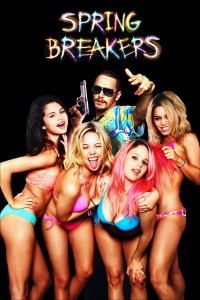
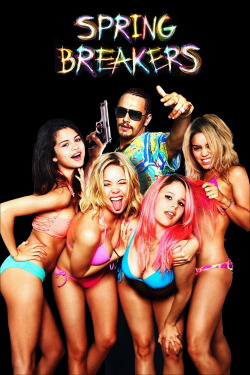
Whereas Tuggle asks a male hitchhiker, "How big are your feet?" Candy, in Spring Breakers, is less coy, holding up a sign for Brit in a darkened lecture hall that reads: I want penis. More than no guilt sex, or to borrow the professor's formal terminology: premature emotional involvement on a first date, what Brit and her friends really lust after is money.
No cutting corners for these toxic princesses; this is a new breed of "kids". To procure a bankroll for their booze-and-drug fueled vacation, they rob a chicken shack, intimidating the customers with squirt guns, hammers, and 'tude.
Safe to say, when Brit, sensing apprehension from her partners concerning their felonious plot, tells them to "act like you're in a movie," that movie isn't Where the Boys Are. Although the girls are no angels; they drink and smoke(Tuggle shows a fake I.
D. to the barkeep, while Merritt and Melanie puff on cigarettes), and have sex(Melanie has multiple partners, the last one ending in date rape), their debauchery is no match for all the bong hits and alcohol that find passage through the half-naked bodies of these libertine sociopaths.
Quite pointedly, the girls in Where the Boys Are dig jazz, dialectic jazz, played by white musicians, akin to Spring Breakers, where Alien, a rapper/drug kingpin, plays hip hop to the sunburnt party people; a white rapper, whose antecedent, Basil, the white leader of a bebop trio, are homologous entities in their appropriation of what is considered to be a black music form.
Given the seamless diversity among Larry Clark's Kids, the fluidity in which the contravening cultural group manipulates the expropriated genre on the beachfront stage would seem to be an intentional ploy on the filmmaker's part, since the diegetic music performed by the co-opting musicians in Spring Breakers, accentuates the unexpressed but readily apparent segregation laws that keeps the Ft.
Lauderdale of Where the Boys Are uniform with one single skin color. At the outset of the 1960 film, the university campus that the girls attend is inundated with snow, and more importantly, a strong gust; an unintentional, but nevertheless, pointed metaphor about a change in the wind that would beget the Civil Rights Movement.
Faced with a remodeling of the social stratum, the girls, conspicuously, head south. Back at the aforementioned diner, a male patron seated next to Merritt, spreads ketchup over a slice of white bread.
Contextually speaking, the innocuous act now reads as her indifference to shed blood, the fallout from racial strife. Although Brit and Candy gun down numerous young black men at Alien's arch-rival's compound, their skin color, arguably, is a matter of sheer happenstance.
They're post-colonial. The victims could easily have been white. Granted, at a seminar, the BFFs ignore a murder scene photograph of Emmitt Till, the 14-year-old boy whose death spearheaded an activism for social change.
And yet, the same girls seem at ease with Alien's crowd, primarily black, at a run-down pool hall. It's Faith, the innocent and sheltered one, cut more from the same cloth as Merritt and her pals, who feels anxious and uneasy in mixed company.
Faith is a proxy, a throwback, the good girl interested only in where the white boys are.
This review of Spring Breakers (2013) was written by Shiira on 22 Apr 2013.
Spring Breakers has generally received mixed reviews.
Was this review helpful?