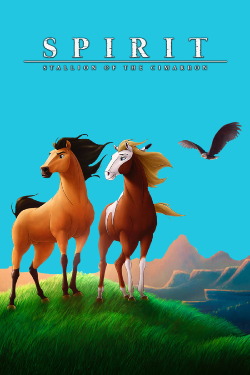
Review of Spirit: Stallion of the Cimarron (2002) by Nathan S — 13 Dec 2018
The cool wind rushes past your face as you run faster and faster. Each step is taken, even though painful, it builds you stronger. You won't fall because you know you have to make it or you would not be able to live with yourself. We all strive to have this same type of grit. Our spirits have a passion to fight for values and those we love no matter our circumstances. We have been taught these morals throughout all time. These morals and values portrayed in one of my favorite childhood movies, Spirit: Stallion of the Cimarron are communicated at a very fundamental level through its themes, soundtrack, and animation.
Themes such as enduring, love, and adventure will carry through the test of time and will always influence audiences around the world. Many movies take on these themes and others deepen them. Spirit: Stallion of the Cimarron, takes on the idea of enduring and unbroken spirits. Throughout the movie, Spirit takes on any task or risk set before him. As Spirit grows to adulthood he also grows into the role of the leader and protector of the herd but he never grows out of his childhood nature. And so, his curiosity gets the best of him as he strays from the herd to explore, only to come across wranglers who take him to a US cavalry outpost. During his time spent here, we see the depth of his spirit, as he fights against his captors. As the Colonel attempts to break Spirit in and ride him, Spirit protests and fights with all the means he has, even after being starved from food and water for 3 days. Here we see into his unbroken spirit and unwavering strength to do what is good. Later in the movie, Spirit is forced to haul a steam engine up the side of a mountain. Even after just losing his best friend, Rain, to the bullet of the colonel, Spirit presses on, standing against the cavalry. At this point he holds true to himself and the other horses to be freed, putting himself in danger in the process. He has a strong will and desire to return to those he loves and to be the protector he was destined to be, and this theme is portrayed in every action he takes. A spirit is something that will always be a part of someone, and can never be taken away. Spirit, himself, never backs down to anyone and is unbroken; he continually fights back and strives for the right he knows to be true. He is the quintessence if what an unbroken spirit is; unwavering, strong standing, and essentially the part of you that will never change no matter the circumstances.
To further strengthen the themes throughout the movie, the producers strategically chose less vocal characters and more powerful music. One of the most powerful elements of the characters is the lack or limit of vocalized speech. Most communication between characters or to the audience is expressed through the body language and actions of those characters. The music in the movie helps to portray the themes and emotions of the characters. Hans Zimmer, an award-winning composer, created the score along with Bryan Adams. The two worked together in composing the music in such a way that the characters emotions are portrayed. The hit song of the movie, "Here I Am", brings a sense of belonging and being, not only to the character but, to the audience. The audience experiences the same emotions of love as the music supports the scene of the movie. Music is known to bring emotion to the forefront of our awareness whether it is good or bad. Music connects certain thoughts and morals to experiences, allowing a deeper connection to be found within the scenes of the movie. Music connects the gap of reality and fiction, pulling the audience into the character's point of view and allowing them to experience the same emotions. Emotions are the universal form of communication; they can express ideas that cannot be put into words, especially to those too young to comprehend the correct meaning of dictation. This method of relying on body language and music communication provides sharing of fundamental values and morals to an audience that is not limited to vocabulary or language. Some might say that this limits the specifics and depth of what is shared because it limits the ideas that can be used in communicating too very basic general emotions. I would agree that communicating through emotions does limit the specifics of what is shared on one topic but it better communicates the values and morals because they are built on a basis of emotion and experience. I would claim that they achieved the goal of better expressing the values and morals behind this film with their choice in the oral communication.
Even though the sound choice of Spirit: Stallion of the Cimarron is powerful, it is the animation that delivered the message to the audience. The whole film used a form of animating that DreamWorks executive Jeffrey Katzenberg called "tradigital animation". It is basically a half and half mix between traditional hand-drawn animation and Digital CGI animation. This animation style gave a very classic, simple, and smooth look to the film because they were able to switch back and forth between the two and get the pros of both forms depending on what was going on in the film. CGI was used in moments where there was lots of motion and specifically camera movements to get the smooth effect that would have been extremely hard to do with hand-drawn animation. One example of this is the scene where the train is tumbling down the mountain. From the other side, we see that hand-drawn animation was used in many spots where there are not as many camera movements and we get a much more artistic and authentic look to the scene. This is shown quite well in the scene where the fat union soldier is trying to clean up spirit so he can be broken and the shots are very still. I do acknowledge that the one set back is the transition between the two can be rough but overall both of these combined to form a very nice and smooth final picture. They provided an easy to read form of the characters emotions and their actions.
Every single one of us has emotions. Even from when we are born we learn through the observation of those emotions. So how can you make something that better communicates to everyone then through emotion that we already know? We learn the values of our own spirit and of the love we have for others through the emotion-driven sound choice and the easy to understand animation.
This review of Spirit: Stallion of the Cimarron (2002) was written by Nathan S on 13 Dec 2018.
Spirit: Stallion of the Cimarron has generally received positive reviews.
Was this review helpful?