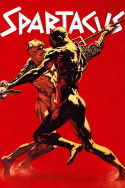
Review of Spartacus (1960) by Cameron J — 06 Jun 2013
"I'm Spartacus; I speak for the slaves!" I'm sorry, but looking at this film's infamous "I'm Spartacus" meme outside of its context, I can't help but think of "The Lorax", and I'd imagine that's the last thing that the makers of this epic historical drama were expecting. Granted, this film also has one of the handful of timeless liberal themes that aren't questionable, like the environmental one promoted in "The Lorax", but the reason why the filmmakers behind this project weren't expecting references to "The Lorax" was because this film is so old that it came out long before "The Lorax", and just in time for Stanley Kubrick to get closer to breaking out as the megastar filmmaker he ultimately became. I don't know about y'all, but I for one am loving how Kubrick's films in the '50s were way too short, ranging from just under 90 minutes to just over an hour, and for this experiment with lengthier dramas, he goes way overboard and ends up with a final product that's almost 200 minutes. Yeah, needless to say, Kubrick got a little bit carried away with his first epic, and he apparently got used to the idea, because this film was just the first of many Kubrick efforts that outstayed their welcome a bit, especially when compared to Kubrick's early work. Hey, I don't care, because Kubrick certainly made plenty of good lengthy films, with this cash cow whose runtime was probably about equal to the size of a cow being anything but an exception. Still, no matter how much this film ultimately proves to be three hours and a quarter very much well-spent, it has plenty of time to take on issues, including, of course, those within pacing.
At well over three hours, this affair is hardly a brief one, being Stanley Kubrick's longest film, which is saying a lot in retrospect (Like I said, he wasn't exactly doing sprawling flicks up to this point), and yet, as lengthy as this compelling dramatic epic is, there are still moments in exposition that feel kind of rushed for every moment in which expository depth takes damage from bloating through excess material that grows repetitious and rather disengaging. Plotting's structure all too often drags its feet a bit, and that's disengaging enough without overlong structuring's being backed by atmospheric dry spells, which aren't so considerable that the film ever truly descends into dullness, but still stand as more recurring as they probably should be, considering how overlong the final product is. Limp spells in atmosphere emphasize limp spells in the narrative, thus crafting bland moments that never fully shake away compellingness, but still dilute the final product's full impact, which may very well be more hurt by writing issues, not of a pacing nature, but of a dramatic nature. The film tells a grand tale set in a very romantic time that is rich with dramatic possibilities, so the depths of the film were never to be too relatable, yet there still several dramatic areas that feel kind of questionable and histrionic. There is enough genuine and reasonably resonant compensation for the melodramatic moments, but there are still more cheesy moments that there should be in the final product, and they would be easier to forgive if their familiarity didn't place them among the many aspects of this epic that are fairly formulaic, because although this film falls under a genre that was being done to death at the time by many an effort that neglected to craft especially unique notes, there's no fully forgiving its conventionalism. Tension goes diluted enough by the final product's being so formulaic for you to focus less on the progress of the drama and more on the other shortcomings, which don't hold the film so far back that it finds itself unable to accel as not simply good, but strong, but still render the project's full potential unable to be fully explored. Nevertheless, the fact of the matter is that through all of its shortcomings in pacing, drama and originality, the final product perseveres as highly rewarding, with potent compellingness and, of course, tasteful artistic value.
Speaking of conventionalism, Alex North puts together a score that follows too formulaic of a pattern to be especially outstanding, yet it's still enjoyable, breathing a liveliness into this film that compliments both entertainment value and the sweep of this epic, whose scope goes truly captured by such commendable aspects as a certain predictable strength: production value, powered by production designs by Alexander Golitzen and Roger Forse, and costume designs by Valles William and Ware Theiss that, when behind Eric Orbom's sharp art direction, create a look for the film that intricately, dynamically and, of course, attractively sells you on a distinctive setting. The film's look is distinguished and immersive, with a grand scope that wouldn't be sold as effectively as it ultimately is without a certain thing that Stanley Kubrick always knew how to work with: cinematography, because even though this film's photographic value wasn't all that groundbreaking, at least compared to the innovativeness of other Kubrick efforts, Russell Metty still does a fine job of delivering on immense, yet immersively intimate framing, as well as clever lighting and coloring that carries a certain handsome richness that helps in defining the final product's look. If nothing else, the film's clever plays with filming help in immersing you into the heat of thrilling action sequences, whose intricate staging and slick choreography are bound to grip as yet another compliment to the final product's value as an entertaining Hollywood epic, something that this film is nothing if not, because as flawed as this film is when it comes to storytelling it hits time and again as spectacle. Still, with that said, the final product wouldn't be as strong as it ultimately is without its substance's wealth, which is diluted by pacing issues, questionable dramatic beats and, last but not least, conventionalism, but not too diluted, as the story concept followed by this film is just so intriguing, with historical importance, a wealth of layers, and much in the way of dramatic opportunity, which stands to be more explored, but is still explored richly enough for the final product to compel, even on paper, thanks to a script that delivers on anything from the occasional memorable high point in dialogue, to dramatic structuring that is inspired enough to give you a generally genuine grip on the depths of this epic. What further sells the film's heart is, of course, the performances, because in spite of its not simply being not quite as well-acted as other Kubrick films, but with the occasional questionable minor performance, there is enough distinguished charisma and layers within most performers to create a fairly strong cast, from which leading man Kirk Douglas stands out with a convincing and enjoyable portrayal of Spartacus' gradual transformation from an ambitious, yet still rather fearful and weak slave, into an inspiringly great and capable visionary of a leader. There is enough strength to the performances to help in driving the compellingness of the final product to the brink of the strength that ultimately claims this epic because of what is, in fact, done right in Kubrick's directorial storytelling, which may have its limp spells, but ultimately charge the film as much as anything, with thrilling sweep and resonant depth that are sometimes moving, often engrossing, and consistently, to one degree or another, worthwhile. At the very least, Kubrick keeps liveliness alive enough to craft thorough entertainment value, because through all of its blows to momentum, when the film picks up, it accels as enjoyable, and with this enjoyment going augmented by inspired style and substance, you end up with a final product that may not be as excellent as it could have, but comes closer than plenty of films of its type and time.
Ultimately, uneven pacing that dances between hurried spots and bloating, - made all the more disconcerting by dry spells in atmosphere - moderately melodramatic, if not fairly cheesy moments, and conventionalism retard momentum to the point of rendering the final product incapable of achieving the excellence that it still comes close to achieving, partially thanks to sweeping score work, intricate production value, excellent cinematography and thrilling action, and largely thanks to the worth story concept whose being brought to life by inspired writing, acting and direction creates the compellingness needed to make Stanley Kubrick's "Spartacus" a thoroughly entertaining and strong epic that proves to be a rewarding classic.
3.25/5 - Strong.
This review of Spartacus (1960) was written by Cameron J on 06 Jun 2013.
Spartacus has generally received very positive reviews.
Was this review helpful?