Review of Soylent Green (1973) by Tracee E — 14 Jun 2010
Pop culture aside, Soylent Green foreshadowed what Blade Runner would become a decade later -- a dystopian film-noir where humanity itself is the core of the film.
Watching the film today, with all the pop culture references to the titular food's no-longer-secret ingredient, it's difficult watching the film without feeling a sense of anti-climax, but there's still plenty to enjoy in the movie. Despite being set fifty years into the future, the characters and the décor are still rooted in the 1970's but, to its credit, it's not reliant on space-age special effects which, at the time, were very difficult to pull off convincingly. As such, the film doesn't show its age as much as, say, Logan's Run.
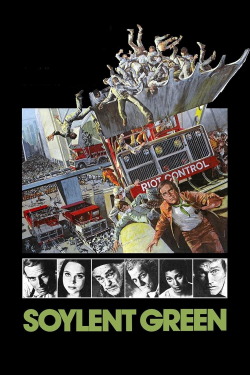
Where the Replicants in Blade Runner saw human life as an aspiration, Soylent Green shows the flip side: human life as an expendable asset. The population of New York City had expanded to 40 million people -- assuming they were confined to the city centre itself and not the urban/metropolitan areas, that's about 5x what it is today. The homeless are relegated to sleeping in disused cars or cramped together in hallways and stairwells - only the affluent are able to live in some kind of luxury. Agriculture is very limited and heavily guarded, with every day commodities like fresh fruit, vegetables and meat fetching high prices. The masses live on thin, tasteless wafers produced by the Soylent Corporation called "Soylent Red" and "Soylent Yellow", made from concentrated vegetable extracts. New on the market is "Soylent Green" -- advertised as being made from high energy plankton. Supply of these foods is significantly lower than demand, and food riots are commonplace where rioters are scooped up and disposed of into giant trucks like human garbage. The protagonist, DS Thorn (Charlton Heston), while investigating the murder of one of New York's most affluent citizens makes use of the deceased's luxuries like soap, Scotch Whisky, fresh food and "furniture" (young female prostitutes/servants who are, effectively, rented along with the rest of the furniture) -- not so much out of dishonesty, but out of desperation to escape the conditions outside.
It's an intensely harrowing story that shows human life in a supply-and-demand situation - and when People > Food, in order to make Food > People once more, you have to redress the balance on both sides. And that can mean only one thing.
This review of Soylent Green (1973) was written by Tracee E on 14 Jun 2010.
Soylent Green has generally received positive reviews.
Was this review helpful?