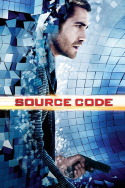
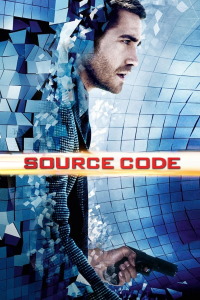
Review of Source Code (2011) by Shiira — 15 Apr 2011
Dr. Sam Beckett(Scott Bakula) never overstayed his welcome. In "Quantum Leap", the great science fiction series that enjoyed an inspired four-year run on NBC in the early-nineties, the time-traveling physicist would supplant body after body like a benevolent demon, solving their dilemmas with the utmost expediency before dispossessing his hosts in a self-induced exorcism that worked like a trigger mechanism predicated on situational closure.
This would prove to be beneficial for our nowhere man because sooner or later, hypothetically(Al, played by Dean Stockwell, a hologram, always kept track of Sam's departure time) the loved ones and acquaintances of the newly-consumed person would eventually discern that they were dealing with an impostor.
If Sam took up full residence in one of the host bodies, this new lease on life couldn't possibly pan out due to his lack of shared histories with the people he'd be expected to be intimately familiar with.
Travel-weary, from all that bouncing along his own chronological timeline, the quantum leaper yearned for a sedentary existence, but the only possible happy ending for Sam would have been for him to return as himself.
To settle down as somebody else, learning the supplanted person's persona like a new language, strikes me as being a little insidious, not to mention, parasitic, and that's the nagging flaw of "Source Code", an otherwise ingenious sci-fi thriller which unfortunately, doesn't know when its time is up.
Once Cpt. Colter Stevens(Jake Gyllenhaal) averts the intended expression of the secondary crisis(the bomb poised to level Chicago that never detonates), thanks to the Afghanistan veteran's time-sensitive(Sam had forty-two minutes, Colter has eight) on-the-fly detective work, his superior, Colleen Goodwin, in gratitude for the captain's hand in apprehending the perpetrator, allows the military's guinea pig to die gracefully, by giving him a chance to save the doomed train commuters with one final rewind of the source code.
(In a sense, "Source Code" is like Woody Allen's "The Purple Rose of Cairo". The real Colter is in a life-support chamber, while the digital Colter, is essentially, playing a part in a movie(the source code can be read as an eight-minute action-short.
In the end, like the Mia Farrow character in the Allen film, the heroine falls for the simulation.) As in Harold Ramis' "Groundhog Day", through repeated stints in the time loop, the self-actualized person accumulates information to affect a different outcome.
By trial and error, Colter learns that the bomb up in the ventilation shaft comes equipped with a backup trigger, a secondary cellphone, which he defuses, therefore changing the predetermined outcome of the program's allotted eight minutes.
Instead of a violent explosion, engulfing the train with an all-consuming fire, the last tick of the program's timecode corresponds to a freeze-frame where the once-victimized passengers' laughter is captured in mid-regale during the last moment of their filmic existence.
Meanwhile, Colter is engaged in an petrified kiss with the woman he grows to love, Christina Warren(Michelle Monaghan), the passenger who happens to be seated across from his train compartment when the soldier leaps into the body of Sean, her teaching colleague from work.
This is how "Source Code" should end: a film-within-the-film happy ending. It's "Groundhog Day" in miniature. Colter learns to live life to its fullest in eight minutes. Reality-wise, these people are all dead, but in the altered source code, the victims of the terrorist attack now get to live, not die, after their running time is up.
The filmmaker ruins the poetry of the moment. But Hollywood, not known for its poetic gestures, especially within the context of a would-be blockbuster, is not going to make allowances for any art-house pretensions, so instead of going out like Anthony Doniel, last seen on the shoreline in Francois Truffaut's "Les quatre cents coupe", "Source Code" tells us that there's life beyond a pre-recording, and sadly, the freeze-frame unfreezes.
That's where the film loses me. Since the soldier sends a text message to Coleen(from within the source code), it must mean that he has his own memories, not Sean's, the man he usurped. As aforementioned, Sam Beckett never overstayed his welcome.
How long will it take before Christina realizes that the man she's with is not actually Sean? How will she react? Colter can't blame his unfamiliarity with the schoolteacher's life on amnesia, or else he wouldn't be cognizant of Christina.
The digitalized woman seems to be in love with an amalgamation(her old feelings for Sean mixed in with Colter's heartfelt pursuance of her). How confusing for her. It's a paradox that "Source Code" may not be aware of.
The filmmaker, perhaps under pressure from the studio, simply rams a happy ending down everybody's throats.
This review of Source Code (2011) was written by Shiira on 15 Apr 2011.
Source Code has generally received very positive reviews.
Was this review helpful?