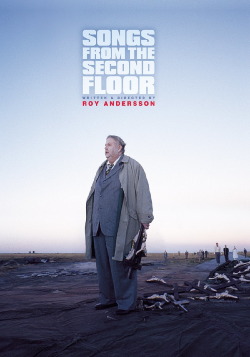
Review of Songs from the Second Floor (2000) by Edwin A — 12 May 2008
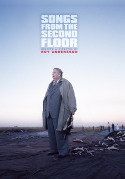
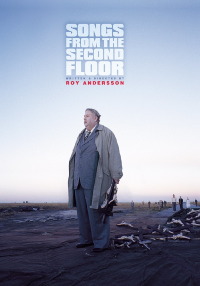
Tragic. Hilarious. Absurd. Those three words fit Roy Andersson's Songs from the Second Floor to a 't.' The film was a success at the 2000 Cannes film festival, winning the Jury Prize and gaining critical accolades internationally. The film is entirely unique, and magical creation of Andersson's mind.
The film follows a number of individuals, some of whom are loosely tied together through personal connections, all of whom share in the existential dread and tragedy of life. We have a magician who nearly saws in half a volunteer, a fired employee, a businessman specializing in crucifixes, and another man who has lost his business to a fire (a fire which he admits he started), his family (including a son who has gone mad from writing poetry), and a series of other characters, not least of which a large congregation of businessmen who walk the streets amid a neverending traffic jam whipping themselves with chains. The storey flows through a vignettes, all captured in long shots by a camera that only moves once throughout the film. The city appears abandoned - save for the traffic jam and roaming flagellants. It's grey and dingy, as abstract a city as could ever be imagined. The people who inhabit it are drab and deathly pale - that the film opens with a man in a tanning bed becomes utterly hilarious in its irony as the film progresses.
There are so many scenes of extraordinary surrealist absurdity that if one was to talk about them all they would need many more pages than available here. Let's consider a few of the most memorable though. In one scene, a woman uses a telephone to explain to someone on the other end that she is stuck in traffic, and cannot get out. She is in a bar; outside we see the line of traffic, moving only as slowly as conceivable without standing still. Everything appears grey, totally abstract as from some world where colours have never been invented. The atmosphere is surreal, and I realize as I describe it I do it no justice at all.
Another brilliant scene involves what appears to be the cities entire population as they gather - businessmen and clergymen alike - to carry out the ritual sacrifice of a young girl, meant to stimulate the stagnating economy. Another excellent scene involves the man who has burned down his store, trying to explain to investigators what he's lost, only to be distracted by the passing hoard of businessmen whipping themselves.
For me however the most amazing scene comes last. In a very long take, we see the crucifix man discard a truckload of his inventory in front of the arsonist. He leaves, and the arsonist takes out his large crucifix and sets it down. We realize that 4 or so individuals have been slowly walking down the road in the background throughout the scene. They've been following the arsonist earlier in the film asking for help. This time he throws a can at them to scare them off. To his and our suprise, dozens of other people seem to pop up out of nowhere from the ground in the surrounding feild. What a shot; it's one of the best I've ever seen, and the camera never moves once throughout its duration.
But I digress. What does it all mean? A quick search of movie message boards will lead you to a number of queries; the dvd also apparantly has a commentary track by Andersson himself discussing and deconstructing the sybolism in the film (I have not seen this yet, and as of now am still unsure if I really want to). The film, I think, a scathing satire of modern society and capitalist realism. It's also about the dangers of mixing superstition and reality. Consider the flaggellating businessmen, self-inflicting pain to stimulate the economy. The sacrifice of the young girl for the same purpose; this also simultaneously highlights how corporations expect us to march towards our deaths each day (ie cigarrettes and alcohol, and so on). The man who burns down his business is shown to be greedy throughout, happy he doesn't have to repay a friend when he commits suicide; yelling at his institutionalized son for not understanding that the purpose of life is to buy something and sell it with one or two extra zeroes.
The paleness of the film often suggests that the city is purgatory, and everyone is actually dead. No one seems to listen, and no one seems to no how to get out. People repeat questions and musings again and again without response.
Andersson has been called the slapstick Bergman, and surely is one of the most interesting products of Sweden. He had pulled a Malick like move prior to Songs from the Second Floor, not making a feature film for 20 some years (although he was active in directing shorts, docs, and commercials). His return was a glorious one though, and one that was entirely original, and entirely inspiring. This is a dark and tragic film, but one that is also funny in that darkest of dark, and absurdest of absurd ways.
This review of Songs from the Second Floor (2000) was written by Edwin A on 12 May 2008.
Songs from the Second Floor has generally received very positive reviews.
Was this review helpful?