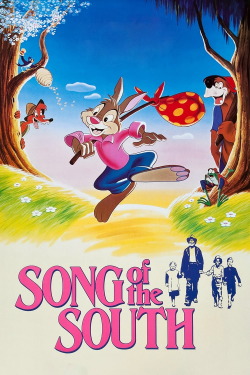
Review of Song of the South (1946) by Richard T — 22 Jun 2009
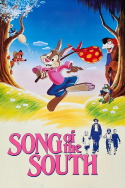
Hot off the heels of Make Mine Music, Walt Disney released the current mark of shame on the Disney name, Song of the South. I have given thanks to this marathon for many things thus far. I have confirmed that Fantasia is probably the worst film ever made, Make Mine Music showed me how great the Fantasia concept could be, the two Latin America films proved that edutainment, a term I have trouble with, can be great fun, the flaws of 'classics' such as Snow White are shown as terrible flaws that combine for an atrocious picture, yet films like Dumbo and Pinocchio can take simple stories and light characterizations and great animation while still turning out a tremendous product, and of course the marathon has shown me the true magic of Bambi. Still, none of that had me prepared for what was about to happen when I sat down to watch Disney's Song of the South.
As we ride down to his grandmother's plantation with Jimmy and his family the audience is made quite aware of the world in which the film takes place. Not far removed from slavery, the carriage rides toward the stereotypical heart of the South, shaky territory for any film to tackle in the 1940's I'm sure, let alone a film coming from a studio known for child friendly fare. The child playing Jimmy brought such a sense of innocence to the character throughout the entire film that he makes that blank slate of a princess Snow White seem like a hooker in Las Vegas at midnight in July. It's truly a terrific performance, he brings so much emotion and humanity to all of his scenes that he effectively sells the wonder of discovery, the magic of puppy love, and the stress that comes when one's world begins to fall completely apart. Now all of this could have easily gone to waste though if it was not for a figure to compliment him, and that brings us to the film's lead, James Baskett's Uncle Remus. The way that Baskett lights up the screen is truly amazing, bringing a sense of wisdom and knowledge to the world and interacting with each character pitch perfect. Apparently Walt lobbied for an Academy Award, I can say Walt had reason to do so. I certainly can see where the claims of racism come up, but in this reflection I will mostly not pay them much mind as I do not completely buy into such a viewing of the film and I certainly think that Baskett does more than enough with the role to transcend many of the stereotypes. So there we have that, not talking about the racism any more.
However, that does not mean that I am done talking with the film's legacy. Going over wikipedia, yes I know it's not really reliable but just hang with me for a second, Roger Ebert has apparently said that the film should be withheld from children because they tend to take things more literal than adults or something of that sort. Oddly, one of the film's central conflicts involves just such a scene where Mrs. Sally warns Remus from telling Jimmy from telling these stories because he's too impressionable. Just as the film proves that Jimmy needs these stories and, as Remus says, they do no harm and have been around for a long time so they must do good, I find the situation this film is in to be very similar. It's incredibly sad that such a work of art has been lost overtime because Disney does not feel it is appropriate for release and if given the chance I think this film has all the markings of a classic. The direction is really great, one early scene at the lake has the camera working in a manner similar to the forest establishing shots of Bambi, and the performances, as I have said, are really top notch. The film's greatest strength is, somewhat surprisingly, the simplistically strong story. Mostly a coming of age tale, I suppose, the film hits each emotion so masterfully that I found myself moved by the end. The film doesn't take many narrative turns, but it perfectly chronicles the shattering of childhood innocence while also capturing that magic, and had it ended about fifteen minutes sooner it would have been the most diabolical film I've probably ever watched.
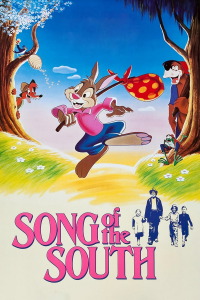
Another strength though, as is expected, comes in the form of the animated segments. While there are only three, and one is incredibly short, the Br'er segments are wonderfully magical and are blended well with the narrative whilst still standing on their own incredibly well. The characters and voice acting are all top notch while the script shows that you can have great and interesting characters without providing incredible character development, in the tradition of Pinocchio, Bambi, and Dumbo. Br'er Rabbit, who just has to be a Tom Sawyer figure, is charming, witty, and a delight while on screen despite not changing much in his three segments. In fact, I may go as far as to call these three the best group of animated characters in any of Disney's film's so far and this statement will likely remain true going to the future. The tales are tried and true, but they are also entertaining to watch and the animation is really nice, though not on the level of Bambi. Still, the way the segments work into the narrative is handled nicely and, much like The Three Caballeros I think that they would do fine holding the weight of an entire feature, though unlike The Three Caballeros I do not think that such a film would surpass this one in quality.
The final thing I would like to talk about is soundtrack. While "Zip-a-Dee-Doo-Dah" is the stand out song all of the songs used in the film are pretty spectacular. There is an incredibly noticeable charm when watching Br'er Rabbit hop around singing "How Do You Do?" or watching Br'er Bear slowly follow along with "Laughing Place" is charming, but the smaller songs that are used by actual people are great, though they usually do not add all that much to the narrative. While previous films in the marathon have integrated music into the narrative, Bambi, Snow White, and Dumbo being the big three, this film actually had songs flow into the narrative in a way that Pinocchio only started to scratch. And the way that final shot is handled is absolutely beautiful, it brings the lighthearted tune that the film makes inseparable from its existence beautiful as the world literally becomes animated and the film is cemented as a marvelously beautiful film. Ultimately, the film is really fantastic and it's a terrible shame that such a work of art is apparently lost in the United States for the foreseeable future. The live action/animation hybrid is a magical ride through the wonders of film and, if I may speak boldly, proves to be, more than anything in the marathon so far, the very definition of a 'Disney' film.
A/A+ or 4.79239472318057823157681029.
This review of Song of the South (1946) was written by Richard T on 22 Jun 2009.
Song of the South has generally received positive reviews.
Was this review helpful?