Review of Some Like It Hot (1959) by Esha M — 02 Mar 2011
4 Stars out of 4.
When it released in 1959, Billy Wilder's Some Like It Hot did not have much going for it. Its story springs from a real-life mass murder, the script was unfinished upon shooting, it was too damn long, and men were dressing as girls. Those just weren't the rules. Fortunately, Some Like It Hot defies generic comedy and inspired the risqué sexuality and dark humour that 1950s America would frown upon. But the film was beloved then, maybe as an anomaly, and is appreciated today as a screwball emblem.
The Galacian-American Wilder was fresh off the wild success of his adaptation of Agatha Christie's play Witness For The Prosecution. Since he was a writer in Berlin for the tabloids, Wilder had the dexterity to embellish classic stories. It was no surprise his penmanship elevated his modestly shot films to great heights. Wilder was hailed as a writing virtuoso and his audiences and critics expected nothing less.
Well, Some Like It Hot was a stellar push forward in this direction. Wilder, known for his tight plotting and emphasis on character made a film much better than it deserved to be. The premise is so goofy, harebrained, unfocused, and fast-paced. Yet it works, with genius precision. It starred two adept comedic talents Tony Curtis and Jack Lemmon as star-crossed musicians who cannot get a gig in the law-binded city of Chicago. Prohibition was enforced and Speakeasies were the only place a low-level musician could salvage a gig.
The two musicians, Joe (Curtis) and Jerry (Lemmon), witness the execution of several gangsters, in a mock form of the St. Valentine's Day Massacre. Obviously, nothing was mentioned about Al Capone or Bugs Moran. The Capone figure is 'Spats' Colombo (George Raft) and Moran is 'Toothpick' Charlie (George E. Stone). Joe and Jerry escape the scene, but are spotted by the gang. In an impulsive fit, they decide to join an all-girl musical band that is touring in Florida. Why not just run? Because in the 1950s no one would expect a man to dress as a woman. That was not custom, even if it meant a bullet in the brain.
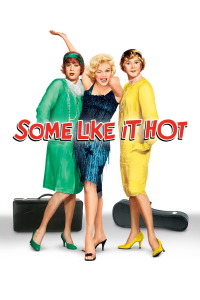
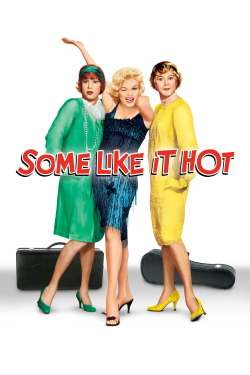
They are acquainted with a charming, boozy, and idealistic singer named 'Sugar' Kane played by the revered Marilyn Monroe (seems everyone has nicknames in this movie - Joe becomes 'Josephine' and Jerry becomes 'Daphne'). She dreams big of marrying a millionaire and escaping the tirades of her band leaders and settling in a conventional life. The two men - er - ladies (?) take fancy to Sugar and constant hilarious battles of subtext in who will rub lotion on her, have a drink with her, and all that girl stuff. Lemmon and Curtis seem to be in a comedic universe of their own here, mimicking manhood while portraying the pretence of a female. They are drag queens but they refuse to be "the" woman. That is the joke.
The charade in Some Like It Hot is not how Joe and Jerry discover their feminine side, but are forced to strap on some kinky boots, heavy makeup, skimpy dresses, and then play their roles like anguished men. It's like a dog wearing a kitten's costume. Subconsciously though, one of them starts to adapt the psychology of the traditional woman, becoming very aware of their sex appeal and even becomes engaged with the old, gasp-laughing playboy Osgood (Joe E. Brown). Joe keeps having to remind himself "I'm a girl, I'm a girl, I'm a girl" in order to maintain that facade, but by then practically begs to rid of his dresses and pantyhose.
Some Like It Hot, being directed by the great Wilder (known better for Sunset Boulevard), makes this comedy the closest in can be to mainstream entertainment. It is easily the best piece of mainstream comedy ever made, if not the best of all comedies. This is ironic since it follows no conventions, distorts emotions, and mocks its story constantly.
Lemmon and Curtis have this penchant for the self-aware. They are as baffled of their gender transformation as we are to them. In 1959, no one did that. But the classic element of screwball is introducing a female character rather outlandish to standard genre. Before 1959, no one had ever pictured two protagonist drag queens. Since then, the mimicry is incessant: Bringing Up Baby, I Was A Male War Bride, and Mrs. Doubtfire. Those all have their own contexts but Some Like It Hot was the best. It was 1929: the Prohibition era, the dames were wild, the decade was roaring - and there were gangsters. What more can you ask for?
The fancy thing about Some Like It Hot is that so many arbitrary, yet inventive bits form that we forget about the general plot. The men try to win the heart of Sugar and thanks to Monroe's ecstatic yet, when it needs to be, forlorn performance her Sugar demands much sympathy and love from us. Her naiveness is quaint and her character has a dimensionality of its own.
Wilder, unlike Hitchcock or Welles, did not believe in panache and believed shots that called attention to themselves distracted the audience from the story. This does not surprise considering most of Wilder's films are concerned with story over style. Some Like It Hot is one of my few favourite films where I can say its cinematic technique did not give it that transcendental appeal. No tracking shots, dolly zooms, push-ins, or surreal composition to convince me.
This is a film of pure storytelling, of random sequences that are so joyful due to that aforementioned writing of Wilder (and his co-writer Iz Diamond). The one time I noticed an obvious stylistic set piece was when Joe and Sugar frolic and the camera whips to a separate setting of Daphne and Osgood doing the Tango. The camera's movement was apparent, but it was the energy of the music in one and the undiluted romance in the other which emphasized the contrast in mood and the subtle humour and more explicit urgency.
By the time the gangsters arrive, it no longer matters. Wilder has taken us beyond that simple premise and created a story of tremendous wit, snappy pace, and endlessly enchanting scenarios. The film inspires the dreams, hopes, tedium, and blitheness of being a women, or more accurately, pretending to be a women. Not that it is dreadful to be a woman. Wilder is not crude. He is, but not in that way. He simply mocks males and their ability to adapt to opposite gender characteristics, even while facing death.
Some Like It Hot was to be shot in colour, probably to evoke the film's visceral comedic edge. It was well-written but they must have felt that colour completed the screwball patina. However, Wilder used black-and-white to enhance the period setting but more importantly, to fulfill the Lemmon and Curtis's request to mute their makeup. A classic, underscoring excuse for the repression of combined masculinity and femininity. Here, the joke was on Lemmon and Curtis. But - heck - as Osgood philosophically reassured us: "nobody's perfect" (those last lines were actually written the day of shooting that final sequence).
It's an enjoyable, riveting, and discombobulated two hours. But not a second is boring and you constantly get the feeling that Wilder is saying more than what the screwball initially suggests. This is Wilder's reflection on American society and how the space for change and unconventional exploration is limited. When Daphne is celebrating her engagement with Osgood, Joe shakes his head, beseeching Jerry "why would a man want to marry a man?" Jerry (Daphne) does her cha-cha-cha, we laugh with exhilaration while noting the faux-pas, and then embrace Daphne's classic response...
Security.
This review of Some Like It Hot (1959) was written by Esha M on 02 Mar 2011.
Some Like It Hot has generally received very positive reviews.
Was this review helpful?