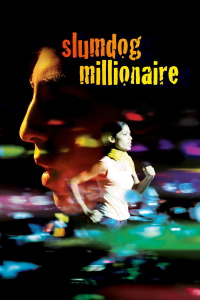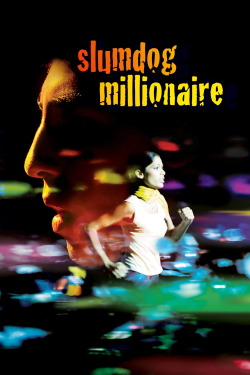
Review of Slumdog Millionaire (2008) by Todd B — 01 Oct 2012
In reality, I could go on all day about the standard features of a film production that 'Slumdog' excels at, be it the excellent pacing, stunning direction from Danny Boyle, the awesome and versatile score courtesy of longtime Bollywood composer A. R. Rahman, or the solid performances from Dev Patel, Freida Pinto, and Madhur Mittal, none of which were out of this world, but together formed a brilliant cast through their chemistry. I could do all that, but I won't. Instead, I will focus on what I believe made this film work on so many levels --- as a drama, a love story, and an inspirational philosophical journey.
Much has been made about the love story central to 'Slumdog's story, but I would like to point out and give credit to the union of the two brothers in the script, played by Dev Patel and Madhur Mittal. While they are relatively simple underdog characters on the surface, as one of my peers pointed out, they also each represent a different philosophy on how to live one's life. The protagonist, Jamal (Patel), embodies idealism in the sense that he strives to live his life in a true and pure way. He has clear set of morals and a code of conduct that he assigns to everyone, not just those close to him. His older brother, Salim (Mittal), is a metaphor for pragmatism, or realism. Salim is a survivor. He makes his way through life with the lone goal of self-promotion, only occasionally pausing to help those close to him. Morals are a guideline rather than a rulebook for him.
Throughout the story, 'Slumdog's' script never clearly chooses which path or philosophy is the correct one. It hints that both are needed to successfully navigate through life, but beyond that, remains silent as far as philosophical preaching goes.
'Slumdog Millionaire' is primarily a Cinderella story infused with philosophical contemplation of moral values. This mix of love story, underdog-against-the-odds tale, and examination of philosophy is what makes the movie work. I freely admit that multiple aspects of 'Slumdog' are cliched and overused in Bollywood, Hollywood, and elsewhere in cinema. However, it is the combination, chemistry, and delivery of all these various elements that make 'Slumdog Millionaire' great. The mastermind behind all that is writer, Simon Beaufoy.
Another section which I briefly alluded to earlier, mostly for those who pay special attention to the technical details of films (more so than the writing or character building moments), is the editing and the direction of this picture. Critics will certainly attempt to bully SM on its believability, but there is no way in hell anyone can chastise SM when it comes to the way it was shot, and how those shots were put together in postproduction. First off, multiple scenes stand out for there slick, inventive cinematography, such as the opening slum chase scene, the night train escape scene, and the climax's gangster shootout. Editing stands out in particular with the way the questionnaire MCTs and flashbacks are interwoven and whenever a major music ensemble forms. I could really go on all day about these two facets of filmmaking with regard to SM, however, so I'll stop there. You get the picture.
Lastly, for those people (probably mostly die-hard Bollywood fans) who watch this movie and cry foul at the less than flattering depiction of India and/or the so-called imitation of Bollywood cinema for Western audiences, you really need to get your head out of your ass. The criticism of nations in cinema is nothing new, and it's not going away anytime soon. Condemning a movie solely on these grounds is usually insufficient, unless the holier-than-thou attitude is truly excessive. Anyway, with all the criticism of other large, powerful nations like the United States, Great Britain, China, and Russia so frequent in the motion picture industry, I'm not sure what the big deal is with 'Slumdog.' I will also argue that this film does not take a low-brow, manipulative mode of self-righteousness the way films like James Cameron's 'Avatar' and Kevin Costner's 'Dances with Wolves' do. The dense, beautiful, and sometimes dangerous streets of Mumbai are the setting for this underdog epic, not the focus.
And finally, those who are Bollywood veterans and look at 'Slumdog Millionaire,' saying, "What's the big deal?" I have two responses: First, read the first 6 paragraphs of this review. This movie clearly separates from Bollywood with its gritty style and veteran direction. It may walk and talk like a Bollywood hit, but it is of a different breed entirely. My second response is this: Imitation is the sincerest form of flattery, my friends. 'Slumdog Millionaire's success can only do good for Hindi films, acting as a bridge between Western and South Asian film audiences. That's what happened to me, anyway.
So, this picture is not really Hollywood's and Danny Boyle's take on Bollywood, rather, it is an experimentation of a variety of storytelling devices that chooses its home in India. It is NOT a ripoff of Hindi films. It has virtually nothing in common with them. Because of the aforementioned reasons, I argue that this is one of the few Academy Award dominations that deserved every Oscar it received.
This review of Slumdog Millionaire (2008) was written by Todd B on 01 Oct 2012.
Slumdog Millionaire has generally received very positive reviews.
Was this review helpful?