Review of Sita Sings the Blues (2008) by Katie J — 22 Nov 2009
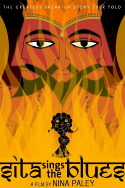
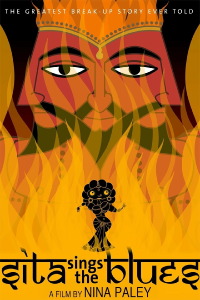
Sita Sings the Blues is miraculous. Few words can encompass just how amazing this film is. Everything about this it is so filled with joy and color; you can?t help but be completely enthralled. At its most basic level, this movie is a retelling of the story of Sita from the Ramayana, but with such an explosion of creativity that it will take your breath away; this 2D animated film makes use of songs by 20s jazz star Annette Hanshaw, classic Indian religious paintings, the silhouettes of paper puppets, and to pull it all together, a story of the artist?s own life, which mirrors that of Sita. Beyond the film itself is another story, that of one woman?s unending determination and perseverance to bring art to life, and do the impossible. This movie is amazing on so many different levels; there is something in it for everyone.
The plot is based on the Ramayana, an ancient Indian epic portraying the abduction of Rama?s wife Sita by the demon king Ravana. In the original story and in most retellings, Sita is merely an afterthought; however, Sita Sings the Blues is told from her perspective. The story is one known to all Hindus, and goes as follows: Rama is the heir of great king, but when the time comes for him to take the throne, the king?s wife calls him out on two favors, and the king regretfully sends his son into exile. Sita goes with her husband, thought the forest is infested with demons. The demon king Ravana hears about Sita?s unearthly beauty, and sends a golden deer to distract Rama. He abducts Sita, and takes her to the island of Lanka. Sita refuses to have anything to do with him, though he threatens her with death. After a month, Ravana says, if you do not sleep with me, I will kill you. In the mean time, Ravana raises an army of monkeys, with his advisor Hanuman. They storm the castle and take Sita back. However, Rama has doubts about his wife purity, though she remained true to him. She submits to a trial by fire, and as she throws herself upon the flames, she is saved by the gods. She soon falls pregnant, and it becomes clear that Rama has lingering doubts about her purity. When he hears a subject beating his wife, and proclaiming that he, unlike Rama, would not forgive his wife?s unfaithfulness, he tells his brother to abandon his wife in the wilderness. There, she lives with aesthetics, and her two sons are born. She teaches them to sing songs praising Rama, and one day many years later, Rama hears them singing in the forest. Sita asks the gods for a final test of her purity, and is devoured by the earth, as her husband looks on in despair.
In Sita Sings the Blues, the story is portrayed by old Indian paintings, which move minimally, and only ever in two dimensions, side scrolling. However, this makes up only a small amount of the actual movie. It is interspersed with interruptions by three Indian silhouette puppets, whose characters are obviously contemporary, and who try, sarcastically and wittily, to make sense of the often confusing and contradictory story. The puppets themselves are beautiful, and wonderfully animated.
However, the most exciting parts of the movie come whenever Sita sings. Paley took old love songs by Annette Hanshaw, a singer from the 1920s, and put them in the mouth of Sita. In these sequences, the characters were hand drawn in flash; Sita highly resembles Betty Boop. Her highly exaggerated curves sway back and forth as she sings. You could be forgiven for thinking that 20?s pop music would clash with an ancient parable, but this is not the case. Hanshaw?s voice is innocent and pure as she mourns the man who did her wrong. She, like Sita, feels no anger towards the man who betrays her, only sadness.
The final part of this movie is the parallel story of the artists own life. It is drawn in a very different style that the rest of the movie- it is more comicy and scrawly; the lines dance across the screen, contrasting with the almost stationary scenes from ancient India. As the story begins, Nina?s husband goes to India for a six-month work program. However, he decides to stay there. When Nina goes to see him, he is completely unenthused about the relationship. When she returns home, she finds an email from him reading, ?Dear Nina, don?t come back. Love, Dave?. Like Sita, Nina was betrayed by her husband, thought she wanted nothing more than to be with him.
The fact that Sita Sings the Blues exists is a testament to the human spirit. Sita Sings the Blues was written, directed, produced, and animated by one person: Nina Paley, a cartoonist and animator from California. With almost no budget, she managed to create this masterpiece on her home computer, using mainly Adobe Flash. When you think of how many people work on a Pixar or Disney film and how much they cost to produce (hint: it?s in the millions), Sita Sings the Blues really is nothing short of a miracle. The amount of work that went into this movie is unimaginable. It is heartening to think of how popular this movie is despite that fact that it had no marketing budget, no mainstream media coverage, and no showings in theaters.
The reason the movie can never been shown in theaters is this: Paley used songs by jazz star Annette Hanshaw in her movie. Now, the songs themselves are not copyrighted, but it turns out that the compositions themselves are still under copyright, despite the fact that they are over 80 years old; they are held indefinitely by corporations due to legal loopholes. They demanded Paley pay $220,000, which she was unable to pay. As Paley explained in an interview with Coilhouse magazine, ?It poses quite a challenge to tiny little low-budget artists like me. What they?re asking for is a really a drop in the bucket for a big studio or a big production. But it?s completely untenable for me, being poor.? She managed to negotiate the payment down to $50,000, but the movie cannot be made available commercially in theaters, and no more than 4,999 DVDs of the movie can be sold; otherwise, she?ll have to throw the monster more meat.
So what did Nina Paley do? She put it up on the Creative Commons. ?Dear Audience, I hereby give Sita Sings the Blues to you. Like all culture, it belongs to you already, but I am making it explicit with a Creative Commons Attribution-Share Alike License. Please distribute, copy, share, archive, and show Sita Sings the Blues. From the shared culture it came, and back into the shared culture it goes,? Paley says on her website. This is not a movie made for profit, for publicity, but is art in its purist form: it seeks only to entertain and inspire. Paley?s story is a lesson to all artists not to be intimidated by corporations, and to insist that you can?t put a price on culture.
Sita Sings the Blues really is a masterpiece. It incorporates so many different things, twisting them up and spinning them out in such an original way that you can?t help but fall in love with the movie. Though it had many challenges to overcome, it is an amazing film. Nina Paley?s work is a reminder to all of us that culture is not something that is owned by big business, but by us all.
This review of Sita Sings the Blues (2008) was written by Katie J on 22 Nov 2009.
Sita Sings the Blues has generally received very positive reviews.
Was this review helpful?