Review of Sita Sings the Blues (2008) by Jerry R — 10 Aug 2012
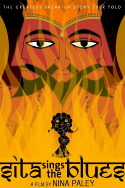
Nina Paley's Sita Sings the Blues is an enchanting, glorious, daffy, animated adventure that represents all the reasons that I love the movies. It is one of those brilliant bursts of imagination that is so much fun that you want to grab as many people as you can to share it with you because you know they'll love it too. I love movies like this. After all the junk, this is the kind of movie that keeps me going.
Sadly, as wonderful as this film it, it has run into a bit of a copyright snag in getting released. Director, writer, producer and editor Nina Paley used songs by the late 1920s jazz vocalist Annette Hanshaw that were not public domain. The copyright on Hanshaw's recordings expired but the copyright on the songs are still in effect. Therefore the film could not get a theatrical release.
The result was one of the biggest coups by any film artist in history. Paley displayed the film for free on her website (you can watch it there right now) at a low resolution and was released on the website as a free download in March 2009 at all resolutions. This allowed the film to generate a growing following (which was also helped by praise from Roger Ebert). All of this was in service of displaying a film that is, for me, pure magic. Paley created a glorious animated fantasy that is part love story, part musical, part Bollywood tribute, part comedy, part melodrama and all parts unapologetic fun.
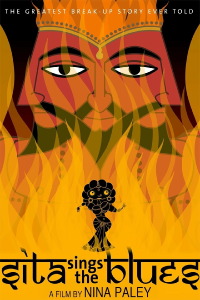
Paley spent four years making the film on her own computer, and is credited the film's director, writer, producer, editor and animator. The result of her labor is a strange, confounding, colorful, daffy and sometimes hilarious imagining of the legendary Indian folk tale of "The Ramayana." In it, Ramayana (referred in this film simply as "Rama") is a blue-skinned Indian prince who dumps his wife when he suspects that she committed adultery while she was in the clutches of the creature who kidnapped her. The story is narrated by three wisecracking shadow puppets who discuss the story in an effort to orient themselves - and us - on the progress of a story that is probably far more complicated than it needs to be.
Meanwhile, in another parallel story, Paley tells her own autobiographical journey of how her husband dumped her and left her with a broken heart that ultimately resulted in her creating Sita Sings the Blues.
The main story, though, involves Rama being forced into exile by his father, at the request of his wicked stepmother who wastes no tears on her blue-skinned stepson. She tells him - with an Indian accent - "Don't let the door hit you in the ass on the way out." Rama is married to the beautiful Sita, and asks her not to join him in his exile, but Sita is determined that a woman's place is next to her husband. She sings the rapturous joy of being with Rama through Hanshaw's evocative jazzy tune "Here We Are" as the two lovers spent time playing hide and seek. Her joy isn't even deterred when Rama kills a group of blue demons who come out of the woods to do harm to the couple.
It is the songs that evoke the most magical moments of Sita Sings the Blues. Sita (pronounced "See-tah"), who looks like a Middle Eastern version of Betty Boop, sings Hanshaw's songs with a sexy, laid-back style and always punctuates the numbers with a happy "That's all" (which was Hanshaw's trademark). All of the songs speak to the situation at hand, and every time Sita opens her mouth to sing, it brings a smile to our faces. Even when she's sad, the film's visuals still evoke a jolly tone. Paley allows the film's visual palette to compliment what is happening to Sita during these musical interludes: When she sings "Am I Blue?" she literally turns blue. When she sings "Lover Come Back to Me", it is accompanied by repeated scenes of her lover dropping her.
Sita maintains her loyalty to Rama, but trouble is afoot when an evil ten-headed king named Ravana is informed by his sister Surphanaka (sporting a nasty set of fangs) that Rama has killed his prized flock of blue demons, so he plots to get revenge by kidnapping Sita. Spurring Ravana on to the idea of a kidnapping, Surphanaka describes Sita this way: "She is the most beautiful woman in the world. Her skin is fair like the lotus blossom. Her eyes are like lotus pools. Her hands are like... from... lotuses. Her breasts like... BIG... ROUND... FIRM... JUICY... LOTUSES." Ravana asks his underling to transform himself into a golden deer to distract Rama while he kidnaps Sita. Blissfully unaware of the kidnapping plot, Sita is snatched right out of her house while in the midst of singing of her devotion to Rama with "What Wouldn't I Do for that Man", a song that eventually proves prophetic.
Anguished over the disappearance of his beloved Sita, Rama plots to rescue her with the help of the monkey warrior Hanuman who - if I understood correctly - was apparently created by the gods just for that purpose. Sita, meanwhile receives a threat from Ravana that if she doesn't agree to marry him, that his blue demons will cut her to ribbons. Hanuman shows up to rescue Sita while she mournfully sings "Daddy Won't You Please Come Home." It is during this number (which includes Sita's own claranet solo) that Hanuman proves to be an adept warrior as one of the blue demons sets his tail on fire and he, in turn, uses it set fire to Ravana's palace. He leaves Ravana's island and returns to tell Rama the whole story. Why Hanuman didn't just take Sita back with him is a question that the narrators debate.
Rama and Hanuman amass a giant army of monkey warriors to return to Ravana's island and rescue Sita. The plan goes into effect as Sita happily sings "Who's That Knocking at My Door?" The blue demons are dispatched with ease and the ten-headed Ravana is decapitated over and over and over again. Sita is delighted to have her beloved come and rescue her, however he is thoughtless, suspicious and jealous. Rama tells her "You have lived in another man's house so you are unfit to be my wife. He cannot have kept you in his house for so long without touching you". Seeing Sita as damaged goods and cuts her loose. Sita is broken-hearted and sings of her sadness with the melancholy tune "Mean to Me".
The conclusion I must leave for you to discover, suffice to say that what passes for a happy ending will depend on how badly you really want Rama and Sita to be together again. This is a film that asks questions about what a woman is willing to settle for from her man. Sita's story is the story of a woman treated cruelly by her man when jealousy overtakes him and the price she is willing to pay for his mistrust.
This is a story that Nina Paley understood all too well. Her story is told in the film in a parallel subplot that is interspersed within the main story. In it, Paley plays herself, a woman living in San Francisco who is dumped by her boyfriend Dave when he gets a job in India and leaves her for another woman. As he treats her like dirt, eventually leaving her a hurtful note: "Don't Call Back", she sits in her roach-infested apartment and falls into despair before pulling herself together and discovering the book "The Ramayana", and sitting down at her computer for four years to write her screenplay.
What came from Paley's discovery is a work of pure imagination. She uses every animation trick at her disposal, and presents three different styles of animation to tell the three stories: First is the narration, which uses the shadow puppets and cut-out artwork to explain and orient us on the story of The Ramayana. As the three try and keep the story straight and help us keep up with the action. The second are the musical numbers, which use a bold vector graphic-type animation which offsets Hanshaw's scratchy recordings. Everything within the frame is always in motion. Sita is always in the center, singing Hanshaw's jazz tunes as the edges of the frame is packed with odd birds and strange creatures who keep in time with the music. Third is the modern story of David and Nina which is animated using rough sketches and crude character designs. These scenes compliment the story of Rama and Sita by suggesting that the reason that Nina eventually sits down to write the screenplay for this movie was that she, in her own way, lived part of Sita's story.
Paley is generous with her visuals. She refuses confine herself within the traditional limits of animation and goes wild with her imagination. There are little moments throughout the film that are pure genius. Take for example, the opening scene which features the Hindu goddess Lashmi rising from the water and listening to a phonograph record - the needle of the machine is the beak of a large bird. When the record skips, the bird hardly seems to notice but Lashmi taps it and the whole screen explodes like The Big Bang.
I also liked a strange moment during the number "Here We Are" when Rama and Sita celebrate their love while Rama dispatches an army of blue demons and the song ends with the spurting blood from the carcasses creating a romantic arching fountain for the lovers. I love the film's two-minute intermission - a sort-of Bollywood tribute - in which the characters cross the screen in front of a closed curtain and return with drinks and snacks from the concession stand (Ravana has ten drinks - one for each head). There is also a nice running joke in which every song ends with Hanshaw's trademark phrase "That's All" which, in the end, nicely compliments Sita's final words.
The film contains at least two dozen moments like that. Sita Sings the Blues represents all the reasons that I love the movies. It is lively and fun, it tells a great story that is equal parts comedy, drama, romance, heartbreak, adventure, comeuppance, revenge, all mixed into a musical that is bouncy and fun. It tells a story that is universal in a way that we've never seen before, using various techniques and camera tricks to tickle us and treat us and allow us regard it with wonder. I like this movie a lot.
This review of Sita Sings the Blues (2008) was written by Jerry R on 10 Aug 2012.
Sita Sings the Blues has generally received very positive reviews.
Was this review helpful?