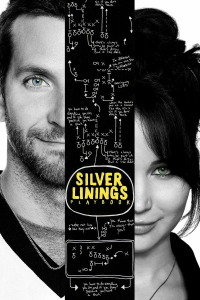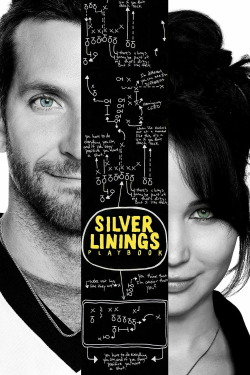
Review of Silver Linings Playbook (2012) by Shiira — 13 Feb 2013
Two endings: one happy, one sad, wind up Billy Brown's malleable story in Vincent Gallo's Buffalo '66, the 1998 cult classic that informs Silver Linings Playbook: sometimes broadly, sometimes not. Like any good quarterback, however, the film calls many audibles and creates something new from the prevailing framework.
But make no mistake about it, the QB scouted the Bills-themed indie. The QB knows the players. Billy, lost and unloved, just released from prison for a crime he didn't commit, inevitably, finds himself at a strip joint, bent on revenge with gun in hand, staring down Scott Wood, a retired placekicker whose missed game-winning field goal prompted in Billy a default on his wager to a local bookie that the designated fall guy couldn't begin to recompense.
As the club's owner, Scott holds court in a private booth, in which the Super Bowl goat, surrounded by topless women, takes a bullet in the forehead before the disgruntled gambler turns the gun to the side of his own temple.
Excelsior, Pat's notion that every bad situation has a silver lining is something Billy doesn't prescribe to, or so it seems, at first. Who is the omniscient QB(read: narrator) that changes the called play: the murder/suicide? Is it the bipolar high school teacher, who similar to the would-be killer, returns home after being incarcerated for a felony(he nearly beats his wife's lover to death), with the difference being that the facility is a mental hospital, not a state penitentiary? Pat, similar to Billy, grew up in a house where the preponderance of football created an extensive amount of dysfunction between parent and child.
When Pat Sr. complains that Tiffany is messing up his team's juju, it reveals how for many Americans, football functions as a sort of pagan religion. In the Brown household, O.J. with the pigskin graces their wall, not J.
C. on the cross. Moreover, Billy is named after the appelation given to the cold weather city's team. Clearly, both men played(and continue to play) second fiddle to an organization of beefy athletes who on Sunday, diverted their parents from the church and into a stadium, the house of laical worship.
Sadly, the discovery made by Tiffany that Pat's catchword doubles as the motto used on the New York State seal, constitutes as a bona fide miracle. In Buffalo '66, god is in the details; the parking lot markings where Billy tries to drive Layla's "shifter car", look conspicuously like hash marks.
The eagle, another detail, the symbol that serves as the moniker for Philadelphia's NFL team, doubles as a sign, a street sign in Buffalo, where Billy crosses Eagle Avenue during his quest for a public restroom.
Therefore "reading the signs," becomes even more pronounced, becomes more than the key phrase from the letter Tiffany writes in order to trick her fellow codependent into participating at a formal dance competition.
She has filmic powers. The audience can read signs, too. Tiffany passes Baldwin(as in bald eagle) Street; she spans time like Billy, but backwards instead of forwards, all the way back to Eagle Avenue.
Blink and you'll miss it, but as Tiffany enters the Ben Franklin Hotel, you see a camera flash go off; it's the photo booth scene updated. Other faint echoes abound, especially the moment in Buffalo '66 when Billy runs into Wendy Balsam, his unrequited childhood crush, whose house he used to walk past, since in Silver Linings Playbook, Pat jogs past Tiffany's place, but unlike Wendy, she comes out of the house, crossing Pat's path and greeting him with a sharp "hey".
Tiffany, the girl who can span time, by running with her stalker(decked out in a garbage bag), it can be construed, is in a sort of extra-diegetical communique with celluloidal Buffalo and its flickering residents.
She's the retroactive ghost in Gallo's film, a conduit from the moving picture future, a second skin beneath Layla, as she coaxes the former Bills fan into believing that he's better than Wendy(who growing up, perceived Billy as garbage), which has ramifications in her own life, since throughout Silver Linings Playbook, she is proving her love for Pat is bigger than Nikki's.
Hypothetically speaking, in the performative sense, Silver Linings Playbook has an alchemizing effect on Buffalo '66. The illusion of fluidity in a static art is enacted. The second ending, the one where Billy's reality turns out to be his imagination, becomes the narrative equivalent of a Hail Mary.
With Pat helming the quarterback position, he throws A Farewell to Arms through the window, through time, like a football. He then goes into his parents' room and complains about Ernest Hemingway, yelling, "Can't anybody say: Hey, let's be positive? Let's have a good ending to this story?" Billy hears the audible.
Outside the nudie bar, he flings his gun into the darkness: a farewell to arms. Because of Tiffany, excelsior becomes his catchword, too. Layla is his silver lining.
This review of Silver Linings Playbook (2012) was written by Shiira on 13 Feb 2013.
Silver Linings Playbook has generally received very positive reviews.
Was this review helpful?