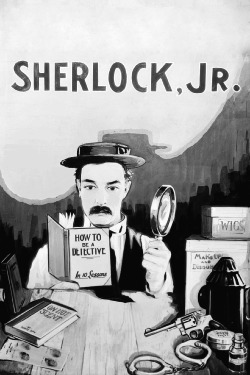
Review of Sherlock Jr. (1924) by Jenn T — 30 May 2011
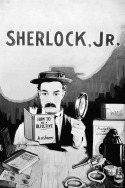
If the name "Buster Keaton" were mentioned to any average individual, one of two films would more than likely be the first to come to mind: The General (arguably Keaton's most famous film) and Sherlock Jr. The former is a fine example of one of the many gems of cinema, and a true classic in every sense of the word. The latter, however, is my favorite from the filmmaker. Sherlock Jr., on the surface, may seem like one of the many silent slapstick comedies to arise from this era. However, it is actually so much more than this. It is, without a doubt, the most accomplished work from Keaton himself. Though it may not conceive as many wholehearted belly laughs from the audience, the simple fact that so much creative and profound genius could arise from film clocking in at just about 45 minutes long is amazing in and of itself.
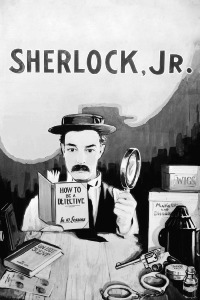
In talking about this film, it would be of preference to divide it up into two parts. The first part is what would be typical of a comedy of this type. Buster plays a cinema projectionist who really wishes to be a detective. However, he's not exactly the most suave individual, and that's where he gets in trouble. As he tries to impress the girl he loves, a rival suitor gets in his way. Soon, our protagonist, ironically, finds himself being wrongfully accused of stealing his girlfriend's father's watch, as he had been trying out his detective skills.
The classic scenes in this part of the film are many. There are a good deal of moments of small-scale gags that exemplify the comedic nature of this film. The part where Buster searches for money in the trash can is one example, as well as the gift of a small diamond which needs to be viewed with a magnifying glass. We are also presented with the awe-inducing, often death-defying, stunts that Mr. Keaton himself is probably most synonymous for. At one point, he becomes trapped in a freight train, and runs along the top of it as it runs in the opposite direction. He escapes by hanging off of a water spout; it spurts water, and he crashes onto the tracks below. This part in particular is a really hard watch for me, since I'm aware of the fact that he actually broke his neck while filming. At the same time, though, it amazes me that someone would have such devotion to their work, that they would risk bodily harm for means of entertainment. If there were a real Superman, Buster Keaton would've been it.
The second part is where the surreality of this film comes into play. One night, the projectionist falls asleep during his job. As he slumbers, he begins to dream; we then see a ghostly double of himself arise from his body, march down the theater, and step into the screen. He then begins to live out his dream; he becomes the elegant Sherlock Jr., investigating a theft of pearls from a mansion.
At this point, we are further presented with a series of physical gags - but this time, it's slightly different from the first half. Just a few moment Buster first enters the theater screen, the backdrop quickly changes. It then continues to change, from inside of a house, to a busy street, to the top of a cliff, and so on; hilarious outcomes are what results. This scene alone is probably what this film is best known for. The humor of these situations aren't exactly one of the side-splitting nature, but rather it encourages laughter out of the unpredictable nature of the scenario in general. Buster had a knack for keeping the audience on their toes, and this scene is a prime example of such talent.
The all-too memorable scenes that follow also demonstrate the previously mentioned vastness. The humor here is much more surreal, more absurd, and some would even go as far as describe the humor in this part of the film as "dark". We see Buster playing billiards, completely missing the 13 ball (which has been rigged with dynamite) every single time. We see Buster jumping through a window, to reappear on the other side disguised as an old woman. And stunts? Yes, there are some, and they are all, unsurprisingly, executed perfectly. He meanders through the busy streets on the handlebars of a motorcycle, which no one else is driving. He takes a romantic ride on a car floating above water, complete with a sail. And this is just the tip of the iceberg. Also, did I mention that this film is only 45 minutes long?
Now, I'm not about to give the entire film away, but if the premise of the film is appealing in any way, shape, or form, I urge you to check this film out. If anything, try to appreciate the undeniably talented individual that is Buster Keaton. I am a really huge fan of this man. In ways, I love him more than Charlie Chaplin. Where Charlie was the professional when it came to incorporating slapstick with pathos, Buster was indeed the more superior director. Though the plot of the film isn't exactly a strong suit, Keaton completely makes up for it with the impressive narrative structure. This film is undeniably different, and in a good way. This is the prime example of good filmmaking, at least given the era this was made.
Unlike most of his feature lengths, this one doesn't exactly follow upon the development of the protagonist. He plays the unnamed projectionist and Sherlock Jr., who are polar opposites of one another, and he executes both roles perfectly. Now, if I have yet to completely convince you to check this out, at least check it out for the equally memorable and hilarious final scene. Keaton's films tend to have that one last moment that supplies the perfect final "kick", and this one is no exception.
I cannot stress enough how much I love this film. With a really crafty storyline and way of conveying it, Sherlock Jr. truly was, and still is, one of a kind. This film also provided apt inspiration for many filmmakers to follow, most notably Woody Allen with his film The Purple Rose of Cairo (which is also a must-see, but that's an entirely different review). Now, I love nearly all of Buster Keaton's films, at least out of the ones I have seen so far. However, I have so much appreciation for this one in particular. It really broke the clearly defined barriers that had been put up for "proper" filmmaking at the time. He truly achieved the impossible with this one, and, in my opinion, cinema as we know it has not been the same since.
This review of Sherlock Jr. (1924) was written by Jenn T on 30 May 2011.
Sherlock Jr. has generally received very positive reviews.
Was this review helpful?