Review of Shampoo (1975) by Omar N — 30 Jan 2009
The first thought that goes through one's mind while watching 1975's Shampoo is how did they manage to make it in the commercial Hollywood system. The answer is quite simple: In the 1970s, Hollywood was a different place, where the directors had all of the control and the studio executives had little to no power or control over any of them. If you think about it in this respect, then the execution of a film like this isn't so hard to believe.
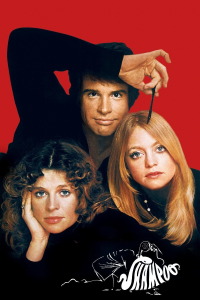
In the movie, Warren Beatty stars as George Roundy, a Beverly Hills hairdresser in November 1968 who wants nothing more than to move up in the World, and he knows the best way to do that is to open his own hair salon. However, he can't get the loans to do it, which frustrates him greatly. But it also doesn't help that he's been having sex with just about every single one of his clients, and he's only truly in love with one of them. The only problem is that George knows that the only way to get through the next 48 hours will be to act straight so that way he can get the attention of the husband (Jack Wardan) of another of the women he is screwing in order to try and secure loans for the salon he wants to own. If only these women would make it so easy, and also the fact that he's trying to cover up his own affairs in the process.
When it comes to the '70s, it hard to think of a more influential director than Hal Ashby. Previously making a name for himself with the cult classic Harold and Maude, it was Warren Beatty (who also co-wrote and produced the film) who gave Ashby his big break with this film. Shampoo is a film that breaks almost all of the rules throughout its 109-minute runtime, mainly because its essentially about a selfish prick of a man who does what he does and asks questions later. In the regards of George, it's not entirely his fault. The problem is every single one of the women he comes into contact with throughout the film simply can't resist him, and that even includes the younger daughter (Carrie Fisher) of one of those woman. It's actually in this scene that he actually tries his hardest to control himself, but in the end can't help himself at all.
The film also opens and ends with the most ironic piece of music ever: "Wouldn't It Be Nice" by The Beach Boys. I never thought I would ever call it an ironic piece of music, but after seeing this film, it's a song that's really about dreams and the hope that they will come true. In the beginning of the film, it comes to symbolize George's dreams of opening a salon and hopefully eventually settling down with just one woman, but by the time the song creeps up again in the closing credits of the film, everything that has transpired throughout the film has changed the whole context of how we heard it at the beginning of the film, and all of a sudden, the world that George had envisioned for himself now looks all the more bleak because of it. Why and how though are the reasons you must see the film.
One of the reasons Shampoo works so well is because of the magnificent cast. Beatty is no surprise, especially considering his reputation of being a ladies man is what he is truly notoriously well known for. But he comes to grips with it in this performance, especially towards the end with two extremely well-played scenes (One with Goldie Hawn, the other with Warden) where he tries his best to explain himself. Whether or not its understandable is something you would have to make your own judgement about. Lee Grant, who plays Felicia, one of George's clients, is the craziest of all of his affairs because she is the one who would seduce him no matter what (even in front of her own husband for that matter). To us, it seems that she is the only one who knows everything that George has been doing, but she doesn't care because she is married and it makes no difference to her whatsoever. Then there's Goldie Hawn, who plays Jill, the only one of these women who thinks that George is all hers, but doesn't know the half of it. When she finds out of the betrayal first hand, all hell breaks loose, and in a way, it's a situation that only George can fix, but the damage has already been done, so what else can really be done. And that leaves Julie Christie, who plays Jackie Miller, who may or may not be the one that is for him. But in many ways, she is really the only under-developed character in the story, as she seems to be there for filler and nothing more. That last sequence of the film should be the big moment of the picture, but because we know next to nothing about her at that point, the ending does make perfect sense. Still, for a character that is essentially filler, she still does quite well with it. All of the performances have something in them that makes them all work (Grant and Warden were both nominated for Oscars, with the former walking off with an Oscar as well), which makes it the perfect Actor's movie.
Still, if it weren't for the script (written by Beatty and Robert Towne), these performances would be meaningless. The script gets the point across so crystal clear that we didn't even need to see any of the sex that is enveloped around it (Thank God Ashby didn't care to make these scenes erotic, as it would have given us the wrong idea). Still, my favorite thing about the script is the choice of setting. It is set on a specific date (November 4, 1968), which was Election Eve that year, and what it symbolizes is the change that is coming into the country. The Summer of Love is ending, and once the election is over, change will come no matter what. The irony of that is that George is not willing to change and even when the film gets to its final moments, we're not sure if he will change as well or not, but with what has transpired in the last 48 hours, if nothing else, George will at least be a lot more wiser if nothing else.
In short, Shampoo is a classic, but its more of an underrated one at that. It is though by no means a masterpiece, but for its time, it is a relic that is worth rediscovering. There are enough laughs and enough tender moments throughout for the film to relate to many people. It also helps that the script is a great piece of writing almost all the way around. If you want to see a film that bends and breaks the rules in almost the same breath, Shampoo will most likely be for you. Besides, I highly doubt you'll see another film about a philandering hairdresser ever again.
This review of Shampoo (1975) was written by Omar N on 30 Jan 2009.
Shampoo has generally received positive reviews.
Was this review helpful?