Review of Shampoo (1975) by Paul Z — 28 Jul 2010
I'm still not sure why, but Shampoo is set during a 24-hour period in 1968. So in one day's time, Nixon will be making his victory speech on television, promising an open administration. In two days' time, George, a hairdresser, will have managed the destruction of three affairs, fleetingly laid a potential fresh prospect and experienced the shambles of his false impressions. Shampoo never totally unites its images of American averageness and individual fool's paradise, although perhaps it doesn't need to. Perhaps the indication is that in a country that doesn't communicate, doesn't believe naked truth, what you wind up with is a Nixon in office and a stranger in bed.
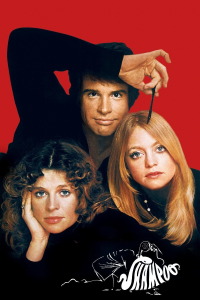
George is played by writer/producer Warren Beatty as a celebrated Beverly Hills hairdresser and sexual superjock. He has sex gleefully with innumerable customers, not so much because he's wanton as because he's motivated, and always has been: "As long as I can remember, when I see a pretty girl and I go after her and I make it with her, it's like I'm gonna live forever." It's an optimistic outlook, although throughout the 40 or so hours encompassed in Shampoo he gets too many pretty girls and too many behind-the-scenes lives confused, and is relinquished confronting a possible future without the woman he (maybe) truly does love. That his future also includes Nixon and Agnew is something he never thinks about and possibly hasn't even picked up on. He drifts amongst a shrubbery of news broadcasts and election-night festivities completely absorbed in his own bafflements.
But if you thought, quite understandably, that Beatty wrote a script where he playing a super-stud would essentially get to bang as many hot actresses as he could, the erotic acrobatics aren't actually what the movie really cares about, and the sex scenes are never elucidated in a sensual way. They're directed by Hal Ashby more as side effects of Beatty's crisis, which is that he likes being affectionate and sweet, he listens to his customers and occasionally even does actually get concerned with their issues, yet in some ultimate way he's too clouded to make a profound connection, to truly give himself.
He's living with Goldie Hawn, a harmless and somewhat elementary girl who innocently thinks she has him to herself. Hawn's best friend is Julie Christie, whose feet are closer to the ground. Christie and Beatty had an affair going at one time, and they revisit it intermittently, though presently Jackie is being supported by an orange-haired fat cat, played by Jack Warden, with obscurely menacing affiliates. Oh, and his wife Lee Grant is one of Beatty's customers down at the salon and in bed. Over the duration of the film, Beatty is also effective in seducing or being seduced by Lester's daughter, so he has the sucker in a checkmate.
Shampoo is a movie I thought I would appreciate exceedingly. It was made by some of Hollywood's most accomplished figures of the time, including its smart, subtle and under-appreciated director, a giant and notable cast that surely pre-sold it, Beatty's co-writer Robert Towne who wrote Chinatown, and its cinematographer the great Laszlo Kovacs, who was influential in the development of New Hollywood-era films and most famous for his award-winning work on Easy Rider, Five Easy Pieces and Paper Moon. But its rhythm isn't self-assured enough to achieve its big ideas. It feels like everyone took this as a holiday. It's not funny or emotional or pointed. It's not the opposite of any of those things either. It's just there. I'd like to say I enjoyed Lee Grant, Hawn, Christie, but all the women run together and none of the men seem to be motivated as much as acted upon.
It isn't as effective as it could have been in the humorous parts. It isn't as brutal as it could have been in its parodies and ironies, like when an elite Nixon clique's election-night party decelerates in an inane string of what seem like fraternity incantations from a U.S. senator, whose manner of conducting himself is so unreasonably far-fetched it doesn't succeed as anything. And it's not as affecting as it could be in its scenes of authenticity, as we can see the mechanisms. We can tell that the movie's supplying compulsory scenes rather than absorbing us in a progression of findings about its characters. It feels as if to have been put together in a stoned daze, where one's ideas and abstractions are so much bigger than one's actual output.
This review of Shampoo (1975) was written by Paul Z on 28 Jul 2010.
Shampoo has generally received positive reviews.
Was this review helpful?