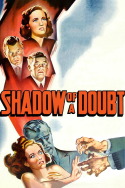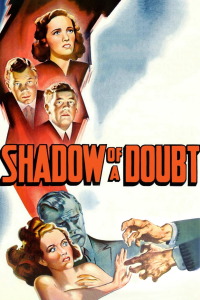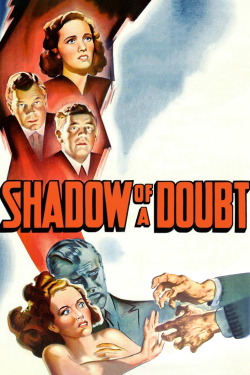
Review of Shadow of a Doubt (1943) by Dave R — 24 Feb 2010
If there was any question that Alfred Hitchcock had his style down pat before the much-lauded color classics, SHADOW OF A DOUBT puts that to rest. The British-born director displays an uncanny understanding not only of the American psyche, but of the forces of evil that prey there. In a time when Hollywood was plagued with quickie melodramas with lackluster talent, the inimitable Master of Suspense cut through the bullshit and produced a film of real quality.
In a seedy New Jersey tenement building, perfectly a propos, we first meet one of Hitch's most memorable villains-- Uncle Charlie. The coldly handsome Joseph Cotten was born to play the part, a role which like all of Hitchock's nemiseses is highly complex and multi-layered. Nothing is black and white beyond the film itself.
Uncle Charlie rouses himself from his contemplations to the discovery that two suit-clad men have staked out the building. The wily Cotten eludes his pursuers and boards a cross-continental train bound for his elder sister Emma's residence, the sleepy small town of Santa Rosa, California.
In classic style, the opening shot of Uncle Charlie is mirrored by that of another supine character, who we discover is the "other" Charlie-- played by the far prettier Teresa Wright. Worried that her household is stuck "in a rut," she implores her father and mother to invite her beloved Uncle Charlie to visit, just to "shake things up a little bit." Her mother demures, arguing that her uncle has more important things to do than visit them.
But of course, before she need despair over her parents having denied her request, Uncle Charlie announces via telegram his impending arrival. "Do you believe in telepathy?" asks young Charlie to the world-weary telegram operator. A running theme, we will discover, is the uncle and niece kinsmanship, in which young Charlie attests that she and her uncle are twins. But are they, really?
The darkness of New Jersey and the subtle moral deficiency we sense in Cotten's character are again seen, in a brilliant shot, when the train's long shadow encompasses the happy family waiting at the station. The potent symbolism, though somewhat below the radar, is just one of many examples of the decrepitude we'll get the vibe of from Hitch's master direction.
The small family of which young Charlie is a prominent member is brilliantly casted, each actor/actress inhibiting their roles sublimely. With the exception of Patricia Collinge's slightly overacted performance as the family matriarch, you sense the cast's preparedness and competence for their respective parts. Also of note is Henry Travers as the father and the know-it-all younger sister, Ann. And not slighting the other family member, youngest brother Roger, but his wasn't much of a remarkable role.
Humor in the film is provided by the banter between a family friend, Herbie Hawkins (the talented Hume Cronyn), and the father. In classic Hitchcock humor, the two hold morbid conversations inspired by the mystery fiction the two enjoy. In my favorite line from the film, Cronyn's character says earnestly: "Well, if I was gonna kill you, I wouldn't do a dumb thing like hitting you on the head. First of all, I don't like the fingerprint angle. Of course, I could always wear gloves. Press your hands against the pipe after you were dead and make you look like a suicide. Except it don't seem hardly likely that you'd beat yourself to death with a club. I'd murder you so it didn't look like murder.".
Together the family welcomes Uncle Charlie to their charming home, a two story affair that perfectly conjures up the innocent feel of the characters. Young Charlie especially is effusive in welcoming her uncle, who at this point gives off ever stronger vibes that he is up to no good, and at first refuses the present he gives her on the grounds that his presence is gift enough. Eventually persuaded to accept it, young Charlie discovers in her all-trusting way that the stunning emerald ring has already been monogrammed-- "CN to LL" or something of the like. Her uncle is quick to call it a jeweler's mistake, and his niece doesn't suspect a thing.
In another scene indicative of Charlie's unnoticed menace, the uncle rashly tears off a piece of the father's evening paper, a piece that we will later discover is tantamount to understanding the crimes Charlie has committed. In another spry defense, he merrily uses the rest of the paper to construct a newspaper house for the children. Young Ann, especially, is not buying it from the outset.
And so the multi-faceted plot boils down to a simple question: will Uncle Charlie's menace threaten the family that adores him?
Not only do the plot and cast draw you into the film, the sleepy Santa Rosa acts as a third character in the movie. Hitchcock chose SHADOW OF A DOUBT as his personal favorite because he so enjoyed the prospect of corrupting an innocent small town with a swarthy villain.
And it's easy to see how he could enjoy it, and why nearly 70 years later it still holds up as one of Hitch's best efforts. A likeable cast, in tandem with the Master of Suspense's direction, is a sure-fired recipe for thrills and chills of the first order. Not a SHADOW OF A DOUBT about it.
This review of Shadow of a Doubt (1943) was written by Dave R on 24 Feb 2010.
Shadow of a Doubt has generally received very positive reviews.
Was this review helpful?