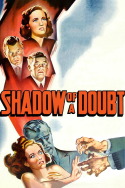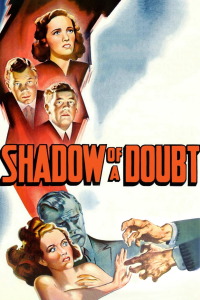
Review of Shadow of a Doubt (1943) by Jordan W — 13 Jul 2010
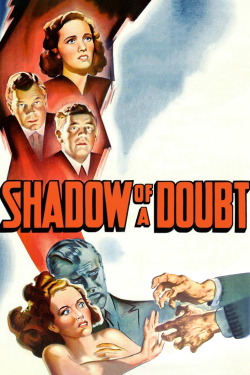
Alfred Hitchcock often stated that "Shadow of a Doubt" was his favorite among his American films. As I finished watching it for the first time recently, it occurred to me that this may be because of just how "American" the atmosphere and aesthetics of the movie are. This can undoubtedly be attributed to Thornton Wilder, who receives story credit on the film, and whose brilliant 1938 play "Our Town" also depicts how unforeseen changes can affect a small American town. Hitchcock's first American film, and my personal favorite of his, was "Rebecca". The change in mood and tone between that and "Shadow" is considerable, and it shows the versatility of the director, as he maintains his style through unique blends of culture and genre.
Charlotte "Charlie" Newton (Teresa Wright) is a bright young girl who is intensely bored and dismayed with her uneventful life. She lives with her family in a small Northern California town where everyone knows each other. That is until she one day decides that she is going to send a telegram requesting her Uncle Charlie (Joseph Cotten), whom she is named after, come and visit. Charlie is her favorite relative, and as she arrives at the post office to send her message, she discovers that he is already en route to visit her and the family. This is where it first becomes clear that there is either something telepathic going on between the two characters, or perhaps Hitchcock and Wilder are playing around with coincidence and chance.
The most interesting thing about the characters that inhabit this small town is that each of them is slightly off-kilter from what one would expect. Charlotte's chirpy mother Emma (Patricia Collinge) pitter-patters around the house, yapping on and on about topics that have long been forgotten by all others in the room. When her brother Charlie arrives, she is so delighted, as she dotes upon his every need and concern, naively shrugging off his bizarre and morose rants about women and the world itself. These moments come quite unexpectedly, and without much warning, as do most of Charlie's darker impulses. He is, after all, her "spoiled" younger brother. Why should he have anything to hide?
With "Shadow", Hitchcock is able to masterfully blend the typical small-town America with the darkness that quietly prowls beneath it. After Charlotte begins to suspect that Charlie is whom the papers are calling the "Merry Widow Murderer", strange and sinister events start to unfold, as a couple of detectives posing as government survey men show up and throw her entire sense of security and perception of her uncle off balance. There are wonderfully placed scenes of comic relief amongst the danger and mystery, featuring Charlotte's father Joseph (Henry Travers) and his friend Herbie (Hume Cronyn), who are both unsolved crime story enthusiasts. They frequently get together and discuss different ways in which they would murder each other. It provides the film with splendid irony and even suspense in one scene when they are at the dinner table discussing how to get away with murder right in front of murderous Uncle Charlie and his next target.
I recently watched David Lynch's "Blue Velvet" for the first time, and I can't decide where my thoughts lie with it until I have watched it a second time. I think that there is an undeniable link to be made between Hitchcock and Lynch's depictions of small-town America being infested and challenged by dark forces. There is a scene in "Shadow" where Charlie takes his niece to a small "underground" club, a place she says she would never normally go. There is a waitress who speaks to them briefly, and it is in this scene that I was reminded of "Blue Velvet". From there, many details that followed also reminded me of Lynch, and of the way that he envisioned his small town USA and all of its quirky, off-center characters. The difference lies in how far the two directors go with the split of dark and light, and how far into each they descend. Hitchcock wisely shows the two sides rather evenly, and often times in the same room together. Unlike Dennis Hopper's character in Lynch's film, Uncle Charlie doesn't live in the darkness, but rather the light; the darkness lives in him, and as his desperation grows, he looses control and is forced to act on his inner impulses.
This is one of Hitchcock's films that I had never heard much about, and although it is now considered a classic, it didn't do much business, critically or financially, when it was first released in 1943. I think it was ahead of its time, as many of his projects were. It is an outstanding piece of work that deserves the highest praise possible. The performances by Cotten, Wright, Collinge, and Cronyn (his first film) are pitch perfect. The writing is so sharp and exciting that I would consider it to be one of my favorite scripts of all time.
Charlotte's mother warns her in one scene, "When you whisper, anyone could hear you a block away." That line is so well timed, and it is one of the many elements of the movie that elevate it to brilliance. It is a difficult task to blend the darkness and the light, and to still maintain such vivid suspense and biting humor. Hitchcock directs with utter precision and nothing less, and brings us another classic thriller that will hopefully be preserved for ages and ages to come.
This review of Shadow of a Doubt (1943) was written by Jordan W on 13 Jul 2010.
Shadow of a Doubt has generally received very positive reviews.
Was this review helpful?