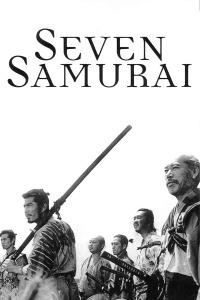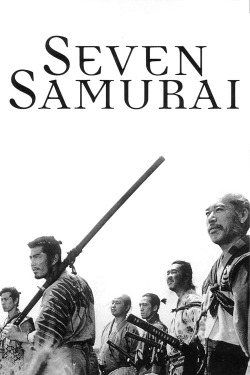
Review of Seven Samurai (1954) by Jim H — 13 Jan 2011
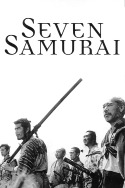
As I watched what is widely considered Kurosawa's masterpiece, I realized that this is quite possibly the most imitated film in American cinema (that is that American cinema imitates this film most often; I know that The Seven Samurai is not an American film unlike one Netflix reviewer who seemed shocked that it was in Japanese; what bothered me most is that two people found that review helpful). The samurai, motivated by honor and charity, agree to protect a peasant village from invading bandits. The basic plot is ancillary to Kurosawa's two major achievements.
First, virtually all of the characters are round. Oftentimes action movies fill the protagonist army with one or two characters who serve merely as brawn, window dressing, or cannon fodder. But here each samurai who meets his end is its own tragedy. And while Kurosawa doesn't waste too much time on back-story, the fore-grounding drama is always compelling, always interesting, and always more complex than what typical films allow.
Second, the opening title cards tell us quite plainly that the bandits are the "bad guys." In another film, they would be given red light sabers. But when we finally get to see the bandits' camp, we're struck by the similarity between the bandits' lives and the villagers'. One of the bandit houses is set on fire, and to validate the bandits' "badness," a woman notices the blaze but neglects to warn anybody. This is the closest Kurosawa comes to demonizing the enemy. Additionally, whereas the samurai are willing the spare the life of a prisoner, the village elder permits his execution by a blood-thirsty crowd and a woman avenging her son. Thus, Kurosawa does what few action films even attempt: he problematizes reductive conceptions of "good" and "evil." Throughout The Seven Samurai, we always know who we're going to root for, but in Kurosawa's hands, we can't be uncritical of our heroes.
For modern audiences used to sharp, stylized action sequences, this film might seem a bit dated. For me, I didn't really care because such sequences rarely adequately compel me. I did have issues with the performances, which I thought were often over-the-top with screaming and yelling where subtlety might have worked better.
Overall, this is an important film, the progenitor of a genre, and almost all of it stands the test of time.
This review of Seven Samurai (1954) was written by Jim H on 13 Jan 2011.
Seven Samurai has generally received very positive reviews.
Was this review helpful?