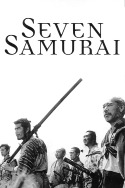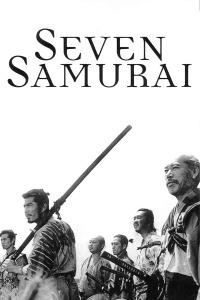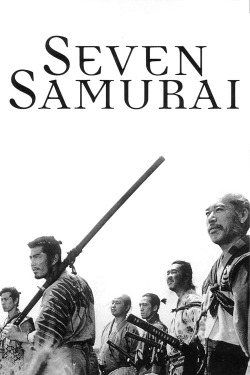
Review of Seven Samurai (1954) by Harpreet S — 04 Nov 2012
Akira Kurosawa's "Seven Samurai" is probably his greatest work because it consists of everything you want from a movie while peerlessly telling its story. There is a quote by Kurosawa: "For me, film-making combines everything.
That's the reason I've made cinema my life's work. In films painting and literature, theatre and music come together. But a film is still a film." Echoing this quote, I will state that "Seven Samurai" has action, romance, suspense, comedy, and tragedy.
My second time watching it, the film on the outer surface is about farmers recruiting seven masterless samurais in defense from bandits attacking their village during the 1500s. Kurosawa's other good or great films are more attentive to a singular notion, while "Seven Samurai" seems to take a bit from each and put it all together in to a masterwork for the ages.
It stars Takashi Shimura and Toshiro Mifune, two of Kurosawa's most reliable actors, along with other Kurosawa regulars that perform exceedingly well. What can you say about Mifune? Hands down one of most astounding of performers, only in seconds he is able to deliver so much emotion and power, unbelievably quick at delivering dialogues and changing pace, going so fast from one expression to another.
I can't think of another director whose world I feel closest to; in "Seven Samurai," Kurosawa provides a world where I wish I had lived. Look at the sequence where the young samurai Katsushiro and Shino meet the first time; before the two lovers meet, we see the young samurai laying in the field full of flowers, or later on Katsuhiro looking and idolizing Kyuzo while he is sitting under a tree, right before he will kill some bandits.
You can say that Kurosawa is an actor in this film, but in the form of Takashi Shimura; we learn everything about the film from him, where and how everything will happen in their strategy; it's as if the director has become a samurai and is orchestrating within the story, telling everyone what to do, when to do, and how to do it.
Kurosawa explores several relationships in the film; the loss of a farmer's wife, a father's fear for her daughter, how Shimura sees the young samurai as a son, how the young samurai idolizes Shimura and later on Kyuzo.
And, of course a young love, the history between farmers and samurais, class struggle, revenge, etc. The film is about three and half hours long and I don't think even a second was wasted; Kurosawa and his staff have mercilessly developed many genuine and profound characters.
The film feels so real, for example: when Shimura is illustrating on how to beat the bandits, going from one location to another, in between we see glimpses of the other samurais training their groups, including Mifune with his relentless humor; the whole film is so full of life! Even the bandits, who we know nothing about, have an aura and imprint of their own.
I might even say I enjoyed the first half of the film more than second, I enjoyed the preparation more than the finale, although it is a grand one; a battle in the rain. The film's title tells us it's about samurais, so does its basic synopsis.
But, what is the film really about? I personally believe it's about friendship and togetherness. Seven people, mostly unknown to each other meet for a cause, but I think the cause is really secondary.
These seven men find company with one another; they find joy and sadness.
This review of Seven Samurai (1954) was written by Harpreet S on 04 Nov 2012.
Seven Samurai has generally received very positive reviews.
Was this review helpful?