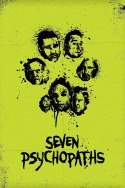
Review of Seven Psychopaths (2012) by James K — 26 May 2014
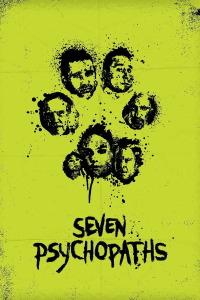
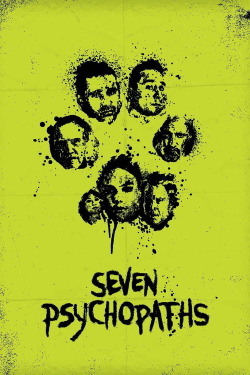
[Spoilers] Rather than explore the premise of seven different psychopaths as depicted in the advertising campaign, the plot of "Seven Psychopaths" follows successful screenwriter Marty (Colin Farrell) - an Irish alcoholic - as he tries to write a script for a film called "Seven Psychopaths." In fact, the end of the film reveals that the film we just watched is in fact the film he wrote, adding a tinge of meta-narration into the mix. Since the film focuses on the writer, the film relies heavily on its dialogue and other trade tools, such as framing, symbolism, and foreshadowing.
Not to be outdone by the focus on story, Marty's best friend Billy Bickle (Sam Rockwell) continuously asks to help write the film. In his version of events, there is a more action-oriented focus, including a big shoot-out in a cemetery where the climax of the film would take place. Throughout the film, the two friends quibble about the content of the script, trying to equally balance each other's desires while creating a credible, high-quality piece of art. However, the biggest problem is determining who exactly the "Seven Psychopaths" will be; fortunately, Billy has a plan to inspire Marty.
Disguising himself (unbeknownst to Marty) as the Jack of Diamonds, Billy goes on a killing spree of "middle to upper-ranked" employees of mobster Charlie Costello (Woody Harrelson). Costello is a true psychopath, showing no regard for human love; yet, he does have a huge love for his dog, Bonny. His full ire comes to fruition when his dog is stolen in a scheme to make money put on by Billy and his partner-in-crime Hans (Christopher Walken), a Polish man of religion who inspires the second psychopath in Marty's screenplay, the "Quaker." More hilarity ensues as Billy, Marty, and Hans team up to play keep-away from Charlie... and to write "Seven Psychopaths.".
Suddenly, the film takes a sudden shift in turn as the trio flees into the desert with Bonny. For several days, the men sit around a campfire in an isolated campground writing the script. Here, the characters become more fleshed out. For example, Marty's alcoholism comes not from his Irish descent, but rather a dissatisfaction with his life - mainly, an inability to write a second film due to a fear of failure (perhaps projection from director Martin McDonagh). Additionally, we learn that Hans's religious convictions have been truly shaken by the senseless murders of his daughter (explained in the "Quaker" backstory) and his wife (at the hands of Costello).
Most importantly, it is revealed just how psychopathic Billy is - he justifies the murders by saying he was trying to give Marty inspiration for the screenplay, but his journal depicts just how much he has to act to seem normal in an effort to be Marty's best friend. Furthermore, he gets offended when Marty and Hans refuse to give him the shoot-out he wants in the play, causing him to call Costello to tell him their location. He then blows up their getaway vehicle, trapping his friends there in an effort to force a bloody confrontation. However, it still does not end up the way he imagines, as only he takes up arms against Costello and his goons. As a final twist of the knife in Costello (who has lost employees, friends, his girlfriend, and his freedom), Bonny refuses to return to his owner after the gunfight, staying by the side of the dying Billy. Eventually, Marty adopts the dog to honor his friend's memory before finishing the script.
Personally, I think the plot is rather meandering. During the exposition, the main story is interrupted by vignettes of the psychopaths in Marty's screenplay. These segments, while entertaining (especially since they have pay-offs later in the film), are jarring, despite their intent to serve as allegories for character development based on their real-life counterparts. This is especially true with Zachariah, a character whose only purpose in the film is to detail his background as a murderous psychopath in one scene (and later in an end credits film that is quite humorous). However, this abrasive tone permeates the entire second act of the film during the campfire discussions about the screenplay. The pace of the film drags quite a bit in this section - the humor in the dialogue and the references to an earlier discussion in which Marty and Billy argue about pacifists versus aggression-ists (in relation to the script) are clever but do not achieve the same excitement or energy present in the rest of the film.
Speaking of energy, the chemistry between the actors is electric. Rockwell carries the film with his excellent depiction of the complex, psychopathic Billy Bickle (last name perhaps a reference to "Taxi Driver"?), following all of the twists and turns with a hilarious enthusiasm that stays grounded through his relationship with Farrell. Marty's stance on pacifism is convincing when countered by his refusal to admit his alcoholism and reluctance to write "Seven Psychopaths." Harrelson's Costello is effectively demented yet loving towards his pooch; it is his absence during the second act that likely plays a big role in sucking the life out of the story. Finally, Walken's emotional depth in the role is stunning, using the humor of his character's demeanor to provide a gripping contrast with the emotional pain that led him to attempt suicide and, later, accept death willingly at the hands of Costello's goons.
Furthermore, the writing is intelligent and witty. The opening scene feels like an homage to Tarantino, with the discussion about eyeballs calling the audience to both relate to and revile the characters that will soon be murdered. The conscious lampshading of the minuscule role of women is hysterical; yet, the three women are well-developed and memorable, each providing an important plot element. Most effective is Myra (Linda Bright Clay), Hans's wife and partner-in-crime, who is killed by Costello moments after learning that she has been cured of cancer. The framing established by the initial conversation about the script between Marty and Billy that outlines and foreshadows the plot of the film (as well as establishing the conflict around the resolution of "Seven Psychopaths") is done effectively and conclusively. Finally, Burwell's score is solid, although it is not emphasized that much in the production.
As a meta-narrative, "Seven Psychopaths" succeeds in balancing characterization and clever writing to tell an interesting story. The concise cinematography, good music, and excellent acting inject the plot with an infectious energy that helps push the film through its pacing issues and interruptions in story. However, the self-aware dialogue and continuity of humor is pervasive and turns the film from a cute diversionary tale to an effectively witty and memorable romp in cinema.
This review of Seven Psychopaths (2012) was written by James K on 26 May 2014.
Seven Psychopaths has generally received positive reviews.
Was this review helpful?