Review of Seven Chances (1925) by Wade P — 28 Mar 2012
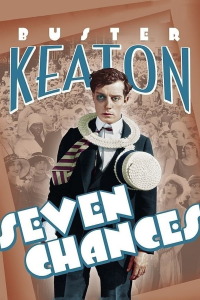
Seven Chances (Buster Keaton, 1925).
Seven Chances was Buster Keaton's least favorite of Buster Keaton's films, so much so that, according to IMDB's trivia page for the film, he attmepted to stop Raymond Rohauer from restoring it. While I can't claim to be intimately familiar with Keaton's catalogue-I've seen, at most, a dozen of the silent classics so far-it's my least favorite of those I've seen as well. Which is not to say it isn't good, it's just not AS good as Cops or The Garage or Sherlock Jr. or... you get the idea.
The plot, based on David Belasco's monstrously popular play and adapted by longtime Keaton collaborator Clyde Bruckman, involves one James Shannon (Keaton), who discovers (after a long period of he and his business partner, played by Sally's T. Roy Barnes) that he stands to inherit seven million bucks. That was a lot of money even in the pre-Depression boom. The catch: he has to get married by 7PM that night. For unaccountably silly reasons, he decides he can't marry the actual love of his life (The Reckless Age's Ruth Dwyer), so he and his partner embark on a madcap quest to find a woman to marry him.
What gets tiresome is the old, old method of advancing the plot in movies: not talking. Would any of the young ladies in the first half of the movie not married him if he'd just walked up to them and said "hey, if I put a ring on your finger, you'll be unbearably rich for the rest of your life?" Of course not (as we are led to believe by the second half, when everyone knows about the inheritance, leading to the classic church scene). The miscommunication between James and His Girl (that's how she's credited) is at least a bit more credible, and leads to what may be the movie's funniest, if a bit uncomfortable these days, moments, as His Girl tries to get word to James that she forgives him through her family's servant, who in going along with the scheme of things is creaited as The Hired Hand (The Scarlet Letter's Jules Cowles). Be prepared for some annoying stereotyping, but there's no denying Cowles was a gifted comic actor; his antics make the last bit of church scene work.
Yes, you will spend the entire movie thinking "this would have made a really funny twenty- or thirty-minute short", rather than the just-shy-of-hour-long short it actually is. But there's a lot of solid comic talent on the screen, and so even when it lags, there's usually still something going on with which to amuse yourself. ***.
This review of Seven Chances (1925) was written by Wade P on 28 Mar 2012.
Seven Chances has generally received very positive reviews.
Was this review helpful?