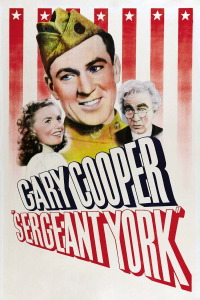
Review of Sergeant York (1941) by Mark K — 24 Nov 2010
Once in a while it's good to look back at classic films that reflected the era in which they were made. At the outbreak of World War II, there was the usual rush to produce films that invoked patriotic feeling in young men, so that they would volunteer for the armed forces. Sergeant York is a lightweight version of such a film, but it's significant in that it really examines the meaning of why people take up causes, even if their own conscience is against them. The heroism was genuine, and it still resonates with people today, because the term is overused. Like the US as it entered the Second World War, it's a film that hearkened back to a more innocent type of patriotism. It's both a war film, and biopic. It was successful in both areas as a movie.
Directed in classic style by veteran actioneer Director Howard Hawkes, the movie take a long time to get to "the front". However, when it does, the connection that Hawkes and his star, Gary Cooper, has made in portraying York ensures that you care about this simple, yet honest soul. Cooper won an Academy Award, and although his performance is typical of his understated style, he's quite perfect for the role. On closer examination, he does go through quite an arc of behavior, and the scenes of his backwoods activities are both amusing and touching at the same time. There's a heartfelt innocence in the way York approaches anything - common sense is what it used to be called. Even his reason for his heroic actions are clearly explained: He did it to save lives, not take lives. He was fighting to help his friends, a sentiment that we hear over and over in modern epics like Saving Private Ryan, Band of Brothers, and other 'modern' war films. Yet this was made in 1941 about the First World War. In that way, it was well ahead of its time, and is remembered when other drum-beating films made during the Second World War are forgotten or dismissed as mere propaganda.
The producers were fortunate to have the real Sergeant York to provide advice and consult on the film. Even he thought he'd been portrayed as 'too heroic', but he liked Cooper's work.
The dialogue is sparse but meaningful, and the narrative picks up speed rapidly after York decides to go to war. The trench warfare of the First World War is shown in some detail, although not in the brutal fashion that it would be done today. However, there's enough to give viewers and idea of how deadly it was, and that only makes York's actions seem even more extraordinary. He was a truly modern hero in a simpler age. We would do well to remember soldiers like Sergeant York, not just because he serves as a heroic portrait, but because he was human as well.
This review of Sergeant York (1941) was written by Mark K on 24 Nov 2010.
Sergeant York has generally received very positive reviews.
Was this review helpful?