Review of Seconds (1966) by Cindy I — 22 Jun 2010
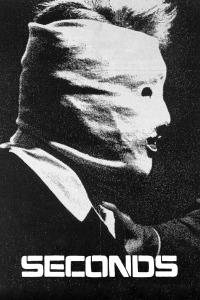
Seconds is a constantly disorienting experience and an edgy, daring film for its time. It unravels from the first moment with strange, ominous image after image after image. It bookends by first blurring, stretching, compressing and pin-wheeling the image of an eye, eventually becoming lucid to begin the story and then blurring the film's final shot into the same pattern of disorientation, as if the movie were all a dream or a stream of subconscious thought. Nearly every shot is filmed with very rare and radical technique or from a spying perspective. Deep-focus and angles galore, and at times what we see on screen changes in our minds without changing physically before it transitions.
Sometimes considered a third in a "Paranoia Trilogy" of movies directed by John Frankenheimer made close together in the very paranoid mid-1960s (the other two being the Cold War thrillers The Manchurian Candidate and Seven Days in May), Seconds however prioritizes delving into the psychological dimensions of alienation over the sociopolitical conditions of the other two, as well as that it is distinguished from the other two as a science fiction story. But it doesn't tell us that by brandishing strange technologies or creatures, or any special effects at all, or anything remotely overt in the sci-fi regard. It is purely based on what the main character is told, and what he believes and thus what we believe.
Frankenheimer's knack for capturing the complicating nature of social situations while still delving into the psychology of his characters is a rare and unique skill. A middle-aged man has grown distant with his wife. His only daughter is married and virtually out of his life. Even his work, which was the centerpiece of his life, has become tedious. A bizarre call from a friend he thought was dead beckons him to a certain place. The boredom and relative apathy bred in American suburbia is handled as a bleak, illusory inner monologue. There is no profound metaphysical epiphany, any authentic one anyway, but the feeling of going to the doctor's with dread, then finding out you're in great shape, only to learn later that more tests need to be done, then that you may go broke waiting to be reimbursed by your insurance company.
As a rule, wouldn't you sedate someone before wheeling them into an operating room to kill them, instead of having some employee just tell them to chill then gag them while having a priest recite last rites? Unless it would deprive a fine actor of an effectively disturbing losing-control scene, of course. And that's precisely what it is, so I let it go. The entire film is subversively designed to get under one's skin. Be absorbed by cinematographer James Wong Howe's hand-held work in certain scenes, mainly two parties that are so riskily visceral and carefully haphazard, in how he infuses that coarse, naturalistic texture of the '60s and '70s with the more calculated, detailed compositions of cinematic surgeons like Hitchcock and Lang. The fearful score. And the sound, particularly that of a faint drill, is horrifically pacifying.
This review of Seconds (1966) was written by Cindy I on 22 Jun 2010.
Seconds has generally received very positive reviews.
Was this review helpful?