Review of Searching for Sugar Man (2012) by Edith N — 28 Jan 2013
Success Is Relative.
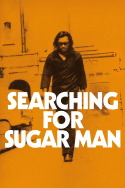
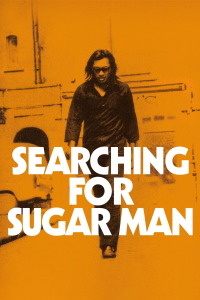
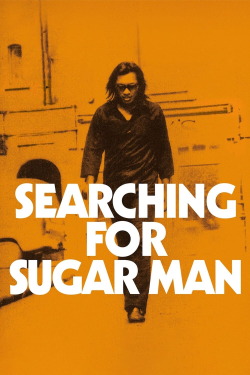
The important thing to keep in mind is that this movie (one of this year's Best Documentary Feature) nominees is not really the story of Sixto Rodriguez. There are a lot of things left unexplored about the man, because the man is only sort of the point of the movie. His apparent minor popularity in Australia isn't relevant to the story, because the people in South Africa weren't aware of it. The story leans on what they knew, what they believed, instead of depending on the facts as they later discovered them. This is also why the filmmakers pretend to still believe that certain things were true until such point as the narrative itself reveals them to be untrue; the story has less force if the facts come first. "This is what is true, and this is what we believed" does not have the same impact as "this is what we believed, and this is what is true." As long as the facts are revealed eventually, the order is less important.
Once upon a time, there was a minor American singer-songwriter called Rodriguez. He made two albums, neither of which were very popular in his homeland. One day, someone came to South Africa with a bootlegged copy of one of the albums, and the people she played it to fell in love. Eventually, Rodriguez became one of the most famous recording artists in South Africa, selling so well that a compilation album, [i]At His Best[/i], went platinum based exclusively on South African sales. His sales there were comparable to Elvis and the Beatles; he was bigger than the Rolling Stones. And no one in the entire country knew anything about him. He was alternately credited on the albums as "Sixto" and "Jesus"--which the South Africans pronounce the religious way, not as the Hispanic name. They were reduced to digging through the lyrics for some clue as to his identity, left trying to determine what such lines as "Born in the troubled city/In Rock 'n' Roll, USA" mean. And a rumour had spread that he'd killed himself onstage!
Now, it would have taken Americans a bit less time to work through some of the clues. As in, I heard that line and immediately knew it referred to Detroit, and that "in the shadow of the tallest building" meant the tallest building in Detroit, not the world. Motown, of course. I can also say that the average American knows that not all geographical references in our music are also biographical. There are certain locations that call up certain moods in the American psyche, and musicians are known to draw on that whether they've ever actually walked a dusty road in Georgia personally or not. There's a metaphorical Georgia which is as important to many Americans as the actual literal Georgia. However, in general, Americans weren't interested in Rodriguez, and the search for Rodriguez came at a time where South Africa was just emerging from its Apartheid-caused cultural isolation. Through most of the story, American musicians were still boycotting South Africa!
Of course, the most interesting trail to follow isn't, probably in no small part because of the legal entanglements it would raise. The filmmakers try to follow the money, figuring that where it ends up is the end of their trail. Not a bad assumption. And since the man was a platinum-selling artist, you figure there's a fair amount of money to be followed. However, the money trail was eventually fruitless. It seems that Rodriguez wasn't seeing any royalties from his sales, because the South African angle to the story came as a complete surprise to everyone who knew him. The filmmakers don't interview much of anyone on the money side; a South African executive says he passed the money on to an American company. His original label had long since gone out of business, and its founder, Clarence Avant, demands to know why the money is so important--is it the story or the money which matters? But I suggest that the money is an important aspect of the story.
Stylistically, this is a more interesting documentary than the other two nominees I've seen. (A fourth is sitting in my instant queue, and the release date for the fifth is not yet known.) This is not a talking-heads style documentary. Like [i]How to Survive a Plague[/i], it relies on considerable use of period footage. There are also what appear to be pencil illustrations used to demonstrate certain moments of the story. Even the writing of the illustrations seems more drawn. The search for the man is part of the film, but it also weaves in strands of the use of music as part of the resistance of Apartheid. (The Rodriguez song which was an anthem for the opposition was scratched on a radio station's copy of the record so that it couldn't be played on air at all.) This is the story of a man, but it is also a story of a nation. The problems Rodriguez experienced in the '70s, when he was writing his songs, are not the same as the ones of South Africa in the '80s, but it's not difficult to understand some of the resonance.
This review of Searching for Sugar Man (2012) was written by Edith N on 28 Jan 2013.
Searching for Sugar Man has generally received very positive reviews.
Was this review helpful?