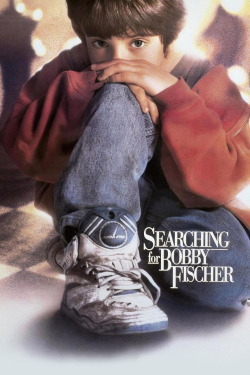
Review of Searching for Bobby Fischer (1993) by Zeek F — 16 Nov 2004
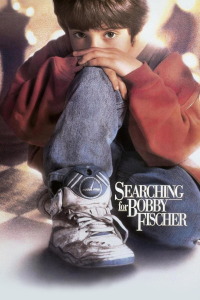
An insightful, powerful film about prodigies and our responsibility, as a society, to encourage the development of these youths and enable to them to achieve success. If a young child possesses an extraordinary musical ability, is it better for the child if you teach him how to create music that can be sold, so he can achieve financial success, or is it more important to teach him to develop his music, as an artist, without regard to financial worth? These are the questions asked in [b][i]Searching for Bobby[/i][/b] [i][b]Fischer[/b][/i], and luckily for us, these are questions that our American society CHOOSES to ask and answer. Only in America would we care so sincerely and deeply about the POTENTIAL of one our nation's youth.
Josh Waitzkin ([b]Max Pomeranc[/b]) is a prepubescent chess prodigy. His father ([b]Joe Mantenga[/b]) encourages him to enter tournaments, to become nationally ranked. His teacher ([b]Ben Kingsley[/b]) wants Josh to play for the beauty of the game, not to achieve titles or ranks. The father and the teacher, fighting for control of the student, provide a fascinating dynamic. Josh's father, recognizing that "Josh is better at this one thing then you or I will be at anything our entire lives", yearns for his son's success. He judges success by his son's accomplishments, on the competitions he wins, on the powerful players he can take down. It is a game, after all, and Josh is almost perfect at it.
Josh's teacher, however, recognizes the same sense of foresight and intuition he once saw in a young [b]Bobby Fischer[/b], and feels that if he can teach Josh a love of the intricate nature of chess as a game of careful strategy and finesse, then everything else will follow later. Art for art's sake, rather than for reward.
[b]Laurence Fishburne[/b] is a thug who plays speed chess in the park, and although Josh excels at this fast, mean, blunt style of chess, his teacher believes that it will eventually hurt his game, that the game of chess is more graceful and elegant than the format played in the park.
These men fight valiantly for the soul of young Josh Waitzkin, who must make big decisions about his career, his values, and his family, even though he's only 7-years-old. Bobby Fischer was similarly a prodigy, beating ranked world players near the same age. In the 70s, after a big Russian tournament, Bobby Fischer vanished, reappearing only a few years ago. In many ways, [i]Searching for Bobby Fischer[/i] is also about our sense of pride as Americans, about the fact that our country's best chess player chose to leave the nation which encouraged his devlopment. If another prodigy is found, how can his talents be developed in a manner that doesn't drive him away, that keeps and nurtures? Bobby Fischer was pressured and harangued as a child, and these stress-factors showed in his grown-up persona; he developed into an eccentric and immature adult. [i]Searching for Bobby Fischer[/i] is a fascinating morality play with an ambiguous definition of success lying at its center.
The film is sumptuously shot, with the smoky, naturally-lit confines of libraries and dens coming alive on the screen. The acting is uniformally stellar, especially by the young [b]Max Pomeranc[/b]. It helps a little if you have a rudimentary knowledge of chess, but it's not necessary to enjoy the film.
[i]Searching for Bobby Fischer[/i] is a film that is filled with emotion, and every second is genuine. The movie does not manipulate. It is a feel-good film that earns the good feelings it invokes. It is also one of my favorite films of all time. Although it hasn't made my list of top 10 all-time films, it would definitely make my top 20.
This review of Searching for Bobby Fischer (1993) was written by Zeek F on 16 Nov 2004.
Searching for Bobby Fischer has generally received very positive reviews.
Was this review helpful?