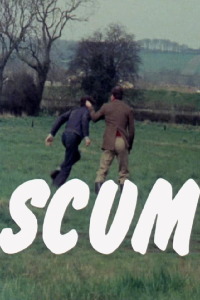
Review of Scum (1977) by Jess W — 27 Dec 2011
In 1902, juvenile offender borstals were introduced with an aim to reform young offenders through the use of military discipline, training and punishment, with sentences from 1-3 years. However through changes in policy such as the reduction of the minimum age (to 15) and with increase in the numbers of offenders, more emphasis was put on punishment rather than training. By the 1970's "Scum" was made, to show a realistic portrayal of the brutal life inside a borstal.
"Scum" follows three boys into the borstal system, showing the revelry between the inmates as they aim to fit in and create a hierarchy, were the strong rule and the weak are left to defend themselves, all under the supervision of the wardens (or 'screws' as they are known). "Scum" shows the brutality within the borstals from both the 'screws' and offenders.
"Scum" has highlighted elements of the borstal system that have subsequently been shown to be ineffective in reforming and rehabilitating offenders such as harsh punishment, no control or autonomy for inmates, military training programs etc.
It has been suggested that there is no evidence that military aspects of borstals succeeded in deterring offenders as it did not address issues of violence and therefore tended to support and encourage aggressive behaviour within the units (Mathews and Pitts, 1998). This can be seen within "Scum" as offenders often acted in an aggressive and violent manor towards each other, this is portrayed within many scenes with one of the most prominent being where Carlin emerges as the 'daddy'.
Harsh punishment by the wardens within the borstals has been seen to be counterproductive in rehabilitating offenders, because of the severity of the punishment and also because their only adult role models are seen to be violent and aggressive. It is stated by Cullen and Smith (2011) that harsh punishment is incapable of reforming offenders. Within "Scum" it is revealed by Arthur (an offender in the borstal system) that there are "more criminal acts imposed on the prisoners than prisoners would on society"?. It has also been found that positive role models for offenders aids rehabilitation (Wolfensberger and Tullman, 1982), however the 'screws' within the film with their sadistic bullying are not providing the positive role models needed.
Also within the film it is shown that the inmates have no control or autonomy, this is demonstrated by the house master, who says to an offender "you don't have to think for yourself in here boy, all the thinking's done for you?". It has since been found that to ensure effective rehabilitation of offenders a small amount of autonomy and control need to be present.
The borstal system was disbanded in 1982, becoming the Youth Offender Institutions (YOIs), where more focus was put back onto training, treatment and rehabilitation. Today's system is based round restorative justice's principles and involves various methods of Incarceration, Tagging and Orders, with varying degrees of success depending on programs that are implemented. A program such as Victim Offender Mediation developed by Nugent (2001) provides an intervention for offenders to make amends to the victims of their crime, which has been found to reduce risk of reoffending.
Also used are prevention strategies, which aim to identify situational and personal risk factors of offenders to create intervention programs. The most successful prevention techniques have been used multi-method which is fixable and effective in reducing antisocial behaviour but not perfect (Bagley and Pritchard, 1998). These strategies have been included in the new system, however in the borstals the general consensus, as presented in "Scum" was that "talks bullshit, you have to lock them up?"(a 'screw' in scum), where no prevention was considered and the norm was to force offenders into incapacitation (borstals), consequently making them institutionalised, rather than examining and targeting risk factors.
However despite the fact that the newer restorative justice models have been seen to be more effective in terms of rehabilitation of offenders (Latimer, Dowden and Muise, 2005), recent social events such as the summer riots of 2011 have lead to a widely held social debate as to whether the current system is too soft on offenders. This has been addressed in the media coverage of the event, suggesting that the "soft" approach hasn't worked in deterring young people from crime, as Antisocial Behaviour Orders and Incapacitation are not perceived as a deterrents, but rather as badges of honour (Halliday and Graham, 2000; Dodds, 2011).
It is this authors opinion there is still a great deal of work to be done and more research needed into interventions and preventions, however there is a need to move forward in forensic and criminal psychology and not back to the harsh reality of the punitive system as depicted in the production "Scum".
This review was done as part of an assignment for one of my third year psychology models and would appreciate any comments or feedback that anyone would like to leave!
This review of Scum (1977) was written by Jess W on 27 Dec 2011.
Scum has generally received very positive reviews.
Was this review helpful?