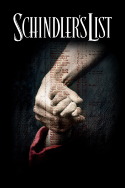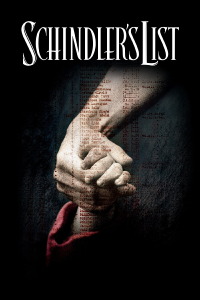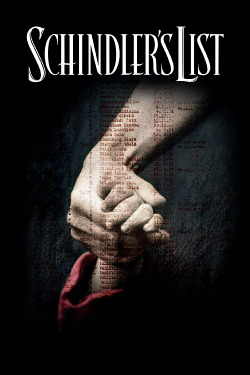
Review of Schindler's List (1993) by Dave M — 23 May 2013
If there has ever been a moment in film history when portrayed historical events are as deeply transmiting and as emotionally transforming as the events themselves, as philosophically endearing as a life of sacrifice, as complex and powerful as the men living it, that's when the art medium is at its pinnacle moment.
The unmistakeable grandeur of ''Schindler's List'' is the reason why I love movies. This is a film that doesn't care about a straightforward plot, or about its characters as elements to propel a story. This is the definitive proof that cinema does not ought to worry about the same concerns in other mediums. Indeed, what Steven Spielberg has captured, in such an expert and masterful way it is beyond any description, is the very essence of the Holocaust and the definitive argument of a racist ideology conceived to mutilate mankind. But more than that, Spielberg and his brilliant crew and cast have taken a picture of one of the most complex processess in human history, and by far the harshest event of the 20th century. Being able to keep all of that in film, using no other elements than cinematic language, is what makes filmmaking itself so unique and distinctive compared to other mediums. This is a film with a world within it. With an entire universe of philosophical and historycistical power taking place solely on the other side of the screen.
''Schindler's List'' tells the story of a German industrialist who arrives at Poland during the Nazi occupation of that country, to invest in factory buildings meant to produce military items for the continous war effort abroad. Nonetheless, after meeting the uncorruptible accountant Ikshat Stern (Ben Kingsley), Schindlers grows aware of the depravation to which Jewish are submitted, particularly during a brilliant 30-minutes scene depicting the liquidation of the Jewish Ghetto in Krakow. After witnessing first-hand the events, Schlinder decides to save as many Jewish lives as he can listing countless Jewish people to work in his factories, without them being the littlest apt for manufacturing. Befriending the sadistic and ruthless Nazi captain Amon Goeth (Ralph Fiennes), Schindler becomes involved with the operations conducted in the Plaszów concentration camp. These are thoroughly depicted in the film, with a recreation so realistic it cosmically surpasses the standards of any pseudo-documentary by National Geographic. Working along with Stern, Schindler writes his list of competent workers he means to save from being transported to Auschwitz, to keep sheltered in facilities where they would supposedly work in war machinery until the German war front was broken and the Second World War over... or until his funds collapse from bribing SS officials and buying the machinery they were supposed to build from other companies. Oh, it ends. The war ends, of course, with the Allies winning. Being declared an enemy of the human race due to his Nazi-member status, Schindler flees shutting down his factories after hearing Winston Churchill's war victory speech. He leaves with the blessing of his 1,200 workers, all unmeasurably loyal and grateful to the blessed man who saved them. Unaware of his accomplishments so far, Schindler is given the last most beautiful works I've ever heard: ''He who saves one life, saves the world entire''. He leaves Europe completely broke. His only wish, to have saved more lives. The epiphany moment, having Schindler mourn over what he considers to be an act of incompetent unresponse, not being able to save at least one more life, desperately craving his possessions and go back in time, is the scene I found most devastating of an already devastating film. After being liberated by the Soviet Red Army, Schindler's Jews go across their shattered nation with the sun over their heads. Fast-forwarding time, they walk over the beautiful hills of Jerusalem to visit Oskar Schindler's grave.
No need to say this is the most beautiful film I've ever seen. I will most likely change that consensus sometime, and what sort of movie buff would I be if I didn't. But the point is, this is a film that has artistry and speechlessness on each it lasts. And it lasts more than three hours.
The film's story treatment itself has a lot to account for contribuiting elements. Some might say it's its depiction of the Holocaust which are ''Schindler's List'''s very essence. I, in particular, found its veracity and amorality much more meaningful than any other Holocaust memorial I've seen. This is perhaps the best dramatization ever made of the event, and also its very best depiction. However, I believe the most impressive things about this film are its two heartbraking unstoppable ulterior forces. For one, this is the best use of cinematography in my experience. The reason for that is its vision, which is at the soul of filmmaking. Being able to express merely with images what a book does in hundreds of pages, is the heart of cinema. The recurrent mottifs working throughout the movie, including the innocent red-dressed girl walking in the occupied ghetto and then being thrown into a giant pile of cadavers to be burned. One of the earliest scenes, that include Schindler selecting about fifty secretaries to work with him, is another masterful use of photography, cinematography and editing. Or the most brilliant bit of visionary filmmaking I found in it, which is the sardonic literary comparison between a scene that has Goeth trying to desperately shoot a Jewish worker with a dozen guns that don't seem to work, but him being condemned to die by hanging years later, only to find that no mechanisms for him dying are working, and the executioners have to kick his supporting chair for some time until he succumbs to the rope. It is the most beautiful irony ever.
No doubt being saved for the mastery of its screenwriting, music is the other trait I consider most relevant. The undescriptibly genius John Williams captures the ontology of the Jewish people in themes that might as well last one minute. Dozens of classic Jewish, Polish and German songs being used in some of the film's most difficult and hurtful moments. In a good tone with ''Schindler's List'''s depiction of the Holocaust, the images and their companion songs are meant to teach.
In 1993 was released one of the best films ever made. If not, then the most rewarding boldest film ever made. With no resource other than a purely visionary cinematic source, this is a film realisation on its very essence.
This review of Schindler's List (1993) was written by Dave M on 23 May 2013.
Schindler's List has generally received very positive reviews.
Was this review helpful?