Review of Scarface (1983) by Tyler E — 28 Mar 2016
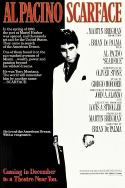
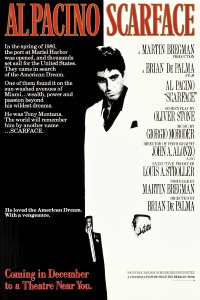
"Scarface" remains to be a singular mob film some thirty-plus years after its release. Ignoring the subtleties and suave attitudes of many of its peers ("The Godfather" series, "The Departed") and going for the guise of a Grand Guignol soap opera, it's fiercely over-the-top, artistically maximalist, emotionally cartoonish, and sadomasochistically violent. Nothing about it is remotely embedded in reality, but maybe that's what makes it such a bewildering experience; it is so pumped up with lethal confidence and mountainous opulence that its carnage is only a part of its aesthetic, to be lapped up with delirium amongst the various thugs and glamorous women.
Taken from an incandescent screenplay by Oliver Stone, "Scarface" is directed by none other than Brian De Palma, whose eminence arrived in the 1970s through several sexy, stylish B-pictures, his reputation solidified by 1976's "Carrie," and later works such as 1980's "Dressed to Kill" and 1981's "Blow Out." The film, though, was his very first big hustle, a piece lacking his previous Hitchcockian instincts and instead heading for the breadth of a magnum opus, epic in length and epic in aspiration. With "Scarface," we play audience to a director being challenged by material that does the talking all on its own, his quirks and nuances hushed down for Stone's subversions but still supplementary in regards to the loud colors of the movie itself.
And so the illustrious exaggerations from Stone and De Palma are perhaps amplified by the film's star, Al Pacino, who is an American actor playing Cuban with all the caginess of Ron Jeremy doing a belly flop into a kiddie pool. Elsewhere, Pacino's theatrical method acting might be observed as overacting. But because he possesses unbreakable certitude and an unsettling of way of becoming rather than portraying, Pacino is "Scarface's" most valuable asset. Without him, the excesses Stone and De Palma so shamelessly promote would seem artificially extravagant; Pacino embodies the terrifyingly believable extremism needed to match the exorbitant textures of the film.
His Tony Montana, as iconic a mobster as Brando's Vito Corleone, is a character that almost immediately announces himself to be one for the ages, our introduction to him as instantaneously unforgettable as Dustin Hoffman's asking of Mrs. Robinson if she's trying to seduce him, as cerebrally permanent as Rita Hayworth's rendition of "Put the Blame on Mame" in 1946's "Gilda." We first meet Montana in 1980, when he's a penniless refugee trying to make it in America. A criminal before his arrival in Florida, only a brief period of what we'd like to call humble beginnings passes before he's back to his old ways. After a series of cutthroat criminal detours, he is hired by Frank Lopez (Robert Loggia), a Miami drug kingpin who sees potential in his unshakable brutishness.
Years pass, and Tony metamorphoses into something more than your average drug dealer. He, after much backstabbing and much petty clawing, rises to the top of his crime keychain, becoming a narcotics lord in a relatively short time. We endure his marriage to Elvira Hancock (Michelle Pfeiffer), a cutting, slinky blonde, his questionable relationship with his sister (Mary Elizabeth Mastrantonio), to whom he is incestuously attracted, his backward friendship with his wingman, Manny (Steven Bauer), and, eventually, his downfall, which is a direct result of getting addicted to his own supply and being too ruthless to remain protected by reputation alone.
For being an opportunistic crime saga, though, "Scarface" is portentously watchable, moving with snappy pace for nearly three hours and never allowing for us to lose our focus. And it's not necessarily in response to a compelling storyline, either; it's more because of its sensational ensemble and its ostentatious style, and how they work together to ensure intensity that we fall helpless in response to. Pacino gives a tour-de-force of a portrayal, and Bauer is handsomely slithery as his devoted right-hand man; but I especially like Pfeiffer as Pacino's snippy, desirable wife, a platinum-haired minx whose own cocaine habit destroys her, and Mastrantonio as the kid sister who vaguely understands the weight of her brother's evils until it's much too late to turn back. And look at the set design that outlines the antics between these actors; are they not underrated support for such overstated drama? Similarly scrumptious is Giorgio Moroder's score, which is synthetic, sparkling, and dated, and yet captures the shabby lusciousness of the movie's parts. ? "Scarface" falls short of greatness only because it never rings as much more than beautifully executed pulp - with an anti-hero more godly than human at its front, it's all sinful fantasy dipped in temptation and power, emotionally unreachable because it's more cinematic than it is ingenuous. But what a deciduous complaint for a film of such adamantine, zealous splendor. There isn't anything like it, and it's better that things are kept that way.
This review of Scarface (1983) was written by Tyler E on 28 Mar 2016.
Scarface has generally received very positive reviews.
Was this review helpful?