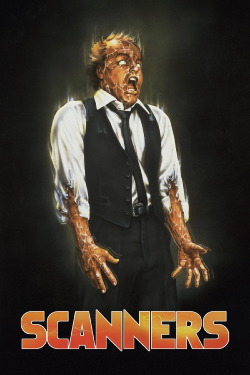
Review of Scanners (1981) by Paul Z — 01 Oct 2009
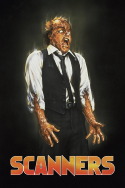
Scanners does not have the gloomy intimacy of Cronenberg's haunting work since, like eXistenZ, A History of Violence or Eastern Promises, even those which shortly followed like The Dead Zone, The Fly, Naked Lunch. But it does have an intellectual drive that makes its cheesiness, often characterized as even laughable, almost disappear. Scanners succeeds The Brood, another early Canadian production by the "body horror" maestro where Cronenberg, as he is here as well to some degree, is still finding that very abstract and even ineffable pitch that would build through his latter succession of films. These two long for the magnified emotional impact of his physiologically and symbolically mutant subjects, but in Scanners, he is realizing the power of Howard Shore's haunting orchestral strains.
Scanners created a cult following I think because the story, about a corporation that attempts to use people with telepathic and telekinetic abilities for its own megalomaniacal agenda, allows for more of an action movie than a psychodrama. Michael Ironside gives one of the most eery and expressive performances as a telekinetic fugitive who does not speak that much, probably because he has a much more bottom-line-oriented manner of getting his point across. There is also a very dubious performance by Patrick McGoohan, who has much stoic character in his face. Many characters are on the run, and rather than shootouts and full-contact physical struggles, they fend off their pursuers and the advocates of them with mental power to explode their heads among other things. It has that graphically violent, blood-and-guts sci-fi action charm that guys who flock to such fare yearn for, but are instead only vaguely fulfilled by myriad extravagant special effects cash-ins.
For all its goofy outdated sound effects and the overall look of the schlock of its era, Scanners does have a high mind. The dialogue is all intelligent and realistic. The pace is actually quite deliberate. These qualities instantly set it apart from De Palma's schlocky rendition of Carrie, Stephen King's popular telekinetic revenge tale. However---though I've always thought that Cronenberg and De Palma, in their respective idiosyncrasies and obsessions, are diametrically opposed in style and approach to such elements of either---De Palma's audience seems to often be discriminate against Cronenberg's films, and a good way of intermingling audiences to diversify the viewer experience could be to pair The Fury, another De Palma film of the late 1970s involving telekinesis and a power-hungry exploitation of it, with this film. They both have a great sense of suspense, spectacle and surprise. But one is purely surface grace and the other has a well of possible interpretations. Fans of both directors should get together and delineate which one is which.
This review of Scanners (1981) was written by Paul Z on 01 Oct 2009.
Scanners has generally received positive reviews.
Was this review helpful?