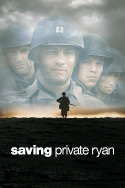
Review of Saving Private Ryan (1998) by Cinemasins — 08 May 2015
Devastating. If, for some reason, I was asked to write a one-word review of Saving Private Ryan, that would be the term I would use. As was true of director Steven Spielberg's other masterpiece, Schindler's List, the impact of this motion picture must be experienced; it cannot be adequately described. No film since last year's The Sweet Hereafter has left such a searing and indelible imprint on my mind and soul. This movie did not need to be released at the end of the year to be considered for a flood of Oscar nominations; it's so forceful that no one who sees it will be able to forget it -- not even Academy members with two-month memory spans.
Saving Private Ryan opens with a 30-minute cinematic tour de force that is without a doubt one of the finest half-hours ever committed to film. This sequence, a soldier's-eye view of the D-Day invasion of Normandy, is brilliant not only in terms of technique but in the depth of viewer reaction it generates. It is certainly the most violent, gory, visceral depiction of war that I have ever witnessed on screen. Spielberg spares the viewer nothing of the horrors of battle, using every tactic at his disposal to convey the chaos and senseless waste that lies at the core of any engagement. We are presented with unforgettable, bloody images of bodies being cut to pieces by bullets, limbs blown off, entrails spilling out, and a variety of other assorted examples of carnage. And, when the tide comes in with the waves breaking on the body-strewn beach, the water is crimson. Those who are at all squeamish will find the opening of Saving Private Ryan unbearable. This aspect of the film almost earned it an NC-17 rating; only the fact that Spielberg rigorously avoids even a hint of exploitation convinced the MPAA to award an R.
In addition to showing what happens when projectiles rip into the soft flesh of the human body, the director employs other methods to capture the essence of battle - hand-held cameras, a slight speeding up of the images, muted colors, and several different kinds of film stock. Put it all together, and it adds up to a dizzying, exhausting assault on the senses. As good as the rest of Saving Private Ryan is, and it's very good, the D-Day attack on Omaha Beach is the sequence that everyone will remember most clearly.
Most World War II movies fall into one of two categories: heroic tales of glory and valor or biopics (my all-time favorite film, Patton, falls in the latter camp). Saving Private Ryan is neither. Instead, it's a condemnation of war wrapped in a tale of human courage and sacrifice. In many ways, the picture painted by this movie is more grim than the one Oliver Stone presented in Platoon, which has often been cited as the most daring anti-war film to come out of Hollywood. Saving Private Ryan quickly and brutally dispels the notion that war is anything but vicious, demoralizing violence that makes a cruel joke out of the human body and spirit. Although the film is only loosely based on a true incident, it's hard not to accept these characters and events as real.
With Saving Private Ryan set alongside Schindler's List, Steven Spielberg, once known as a purveyor of well-crafted-but-lightweight feel-good fare, has given us two of the decade's most gripping, disturbing, and powerful motion pictures. I consider Schindler's List to be one of the most amazing movies I have ever experienced, and, in many ways, Saving Private Ryan is its equal. Although both films take place during the same time period, they focus on different ideas. Schindler's List personifies good (Schindler) and evil (Amon Goeth), and plays out the struggle against a tragic backdrop. In Saving Private Ryan, there are no human villains, and the enemy isn't so much the Germans as it is the implacable, destructive specter of war. The film's central question (When is one life more important than another?) is never really answered. For those who are willing to brave the movie's shocking and unforgettable images, Saving Private Ryan offers a singular motion picture experience. I will be surprised if another film tops it for the best of 1998.
This review of Saving Private Ryan (1998) was written by Cinemasins on 08 May 2015.
Saving Private Ryan has generally received very positive reviews.
Was this review helpful?