Review of Saturday Night Fever (1977) by Jake R — 19 May 2009
1977 was the year Hollywood changed forever. For the best part of the last 10 years a shocking, vibrant, super-charged revolution had turned American movies from turgid, consored trudges into powerful, delirious exercises in style and with newfangled sordid content. Some of the greatest films of all time were made in this period, but by the first year of Jimmy Carter a certain galaxy far far away prove to be the downfall of director-led projects, soon to explode with financial disaster in the early 1980s. However, whilst 1977 will forever be the yar of 'Star Wars', it is also the year when one of the most important films about young people were ever made as well.
The American New Wave had opened the lid on the angsty, grime-filled world the 1970s had collapsed into, with pictures like 'The French Connection', 'Taxi Driver' and 'Network' exposing the facade of calm as a breeding ground for lost, lonely and dangerously unstable souls. But for all the murkiness, there hadn't really been a film that looked at how young people were being consumed by this nihilistic atmosphere. Without a pause, an exploration into the poverty-stricken slums of America's cities swaggered across the cinema screen as arrogant and assured as that famous opening strut down a Brooklyn street.
Young people had been appealed to, and in a lot of ways exploited, at the cinema through increasingly gratuitous sex and violence, but 'Saturday Night Fever' was the first film to take a serious look at real lives, and it's all here, in ambiguous detail: the apathy, the promiscuity and the simple nothingness that blights those stuck in the dead end of life, things now familiar through endless rehashes in modern times, except what elevates this film to much stronger impressions is the presence of a Mr John Travolta.
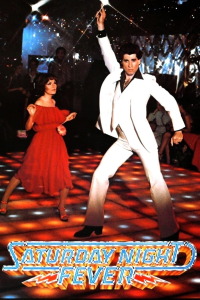
Fresh-faced from a string of lurid, slightly embarrassing movies Travolta literally throws his lithe figure into the unrestrained testosterone of Tony Manero and draws an incredible gravitas throughout the whole picture. Showing off his manly hairiness with some of the tightest outfits excusable outside of a pop concert Manero is an epitome of restless sexual energy, unhindered by a lack of self-esteem, shark-like in his purpose to show off as much as possible. But what makes Manero a more savoury (anti)hero is his humanity, a feature skilfully interwoven into his troubled psyche. Unlike most dea-end youths who mete out their boredom and anger on each other or ordinary people, Manero has his dancing to channel all his extra energy into and it awakens a near-religious passion for dedication. As such, Manero's head is left reasonably clear enough to care about his friends and family, other areas fallen into neglect through selfishness and despair. Both of these worlds eventually collide, inevitably, though not without reason. Manero's frustrated attempt at forcing sex from Stephanie comes not from a feral male instinct but from the fact that his heart has been stolen by her from his dancing, which in turn causes him to lose the vital dance competition with that noticeably more relaxed number. Manero is a much more complex figure than is presumed, which makes him a joy to watch amongst the petty squalor. That Travolta didn't win an Academy Award for his most personal and original performance is a risible mystery.
But it's not just Travolta who excells onscreen. A cast of no-names, sadly both pre- and post- 'Fever', nevertheless populate the canvas with a range of personalities, from the conflicted Frank Jr, to the sniggering simpletons of Tony's gang, to the tragic Anette. These people look and feel real in that effortless way that nowadays seems to take the most intense Method acting to put across.
In the present's post-post-modernism hangover, it's refreshing to find a film that name checks pop culture without having an ulterior motive. Everyone knows that 'Pulp Fiction' is a deliberate exercise in classy but pointless cultural details, all composed for the insight of both the characters and the (now very narrow) audience, but 'Saturday Night Fever' builds in its references to famous movies and musicians because it's simply what young people do.
The 1977 era wasn't one of calculated awards and box office checklists, it was one of uninhibited experimentation, and one of raw reality, which is why there's no significant collection of scenes one can repeat on show reels. Indeed, the most cinematic, as well as the most experimental scenes, are the electrifying dance numbers. Bringing Lester Wilson's twisty choreography to life to the delirious, thrumming beats of the Bee Gees, Travolta leads the way in setting the dance floor on fire. Whether in the unconscious group shuffles or with partners the characters move with unstoppable energy, but its Manero's uncontrollable domination of the disco, at around the halfway mark, that provides the film's most iconic moments. Even more than a quarter of a century on Travolta's exposive grooving makes for mesmerising viewing, one of those moments where cinema comes to life before one's eyes.
In the end, 'Saturday Night Fever' is not the simple 'dance movie' it's perceived to be. It's a far more troubled and tragic story of an older kid taking that last step towards starting a real future, with all the confidence in himself that really matters, and all the respect for people that opens him to others. Peppered with spicy, earthy dialogue and with a sly, almost coky attitude to showing up the darker side(s) to this lifestyle, it nevertheless stays in the heart because of the conviction in its characters, the simplicity in its story-telling and in its nature to be cool by not trying.
This review of Saturday Night Fever (1977) was written by Jake R on 19 May 2009.
Saturday Night Fever has generally received positive reviews.
Was this review helpful?