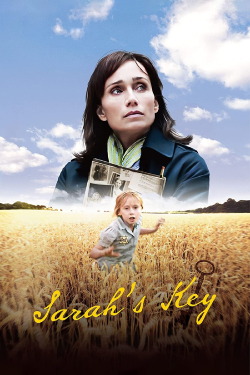
Review of Sarah's Key (2010) by Anastasia F — 22 Sep 2011
Key to the Past.
You are doubtless familiar with the story in all its depressing details from Schindler's List and other movies touching on the Holocaust. The swoop comes without warning: people are rounded up, Jewish people, prior to being incarcerated in the most degrading places, held under the most inhumane circumstances; men, women and children being 'processed' prior to facing some indeterminate fate. So, what's new? We've seen it all before; we know how utterly heartless the Nazis could be, lacking in all human sympathy.
Still, familiar or not, one never quite gets used to the horror in the detail. Picture the scene: it's Paris in the high summer of 1942. There are rumours that the Jewish community, subject to repeated petty degradations, is to be rounded up and deported. Most refuse to believe, preferring to remain where they are. But it comes; they come, as usual in the early hours of the morning.
The roundups begin, people being taken first to an old sports stadium, one with a glass roof, thousands upon thousands of people. It's the middle of July; the sun beats down on those trapped below, trapped like so many flies. Conditions are bad but what makes them even worse is that there is little water and no lavatories. Within days those living in the apartments opposite have to keep their windows closed, despite the summer heat, simply to ward off the stench.
There is one major difference here. The victims are French or those who trusted themselves to the care and protection of the French state, but the perpetrators are not German. No; they, too are French; not fascists, not right-wing extremists, for the most part, but the police and the gendarmerie, all coordinated by a compliant bureaucracy.
Yes, we are dealing with one of the most infamous events in French history - the Vel' d'Hiv Roundup, the first stage of a process that ended in Auschwitz. It's one of the worst acts of gratuitous collaboration; for the Vichy authorities also offered the children, which the Germans did not ask for.
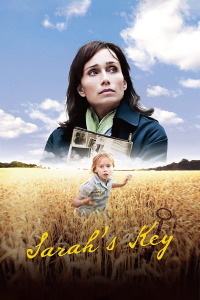
I've watched two movies recently dealing with this incident, both French-made: La Rafle - The Round Up, directed by Roselyn Bosch, and Sarah's Key, directed by Gilles Parquet-Brenner. It's the latter that I want to talk about here.
Based upon Elle s'appelait Sarah - Her Name is Sarah -, a novel by Tatiana de Rosnay, Sarah's Key tells a particular story set against the general background of the Vel' d'Hiv incident; it tells the story ten-year-old Sarah Starzynski, brilliantly and movingly played by ten-year-old Mélusine Mayance, a performance that really made this movie for me.
As her family is caught up in the police dragnet, Sarah, with considerable presence of mind, locks her four-year-old brother, Michel, in a hidden closet in their Paris apartment, taking the key, with the promise that she will return as soon as she can. She has no idea at all how impossible that promise was to be, or how much it would impact on the whole course of her future life.
Her story is the past. It is recovered in the present by Julia Jarmond, an American-born investigative journalist, another strong lead by Kirsten Scott-Thomas. The truths she uncovers in her quest for Sarah are told in flashback, as the movie moves back and forward from the past to the present.
It's also the story of Julia herself and her troubled marriage to Bertrand (Frédéric Pierrot). This, for me, was the Achilles' heel of what is a generally good movie, this tale of two levels. Julia's squabbles with Bertrand, a couple of mature years, over a baby that she wants and he does not, seem trivial against the background of Sarah's story, Scott-Thomas' performance notwithstanding. I found myself more and more wanting to return to the past.
Who could not be engaged, as Julia is through her researches, with the plight of Sarah, ever mindful of her promise, ever mindful of time that is passing, time in Vel d'Hiv, time in one of the transit camps outside Paris, where she, along with the other younger children, is left behind, her mother and father sent ahead in cattle trucks for 'resettlement' in the east. Sarah manages to escape, ever anxious to get back to Paris, helped on her way by a kindly French couple. But weeks have past. There is no happy outcome.
It's in the process of her tireless investigation that Julia discovers a link between her husband's family and that of Sarah, evidence that impacts on them all, raising one crucial question: is it always best to dig up past truths or are some things best left buried? The details are conveyed to her, details of the fate of Michel, in a painful interview with her father-in-law. These circumstances, later conveyed in broad outline to Sarah's own son in an even more painful interview - yes, she survives the war, though tragically and fatally haunted by the past -, might have been better gathering the dust of history. But Julia's quest, the parallel to Sarah's, changes everything she knows about herself and her world. The past, once uncovered, cannot be unknown.
At some points unfocused, at others uneven, Sarah's Key still manages to be an engrossing and moving film, one whose real strength lies not in the incredible -and implausible - coincidences it explores but in its stress on the importance of humanity and the importance of love.
This review of Sarah's Key (2010) was written by Anastasia F on 22 Sep 2011.
Sarah's Key has generally received positive reviews.
Was this review helpful?