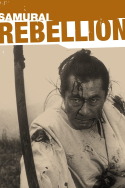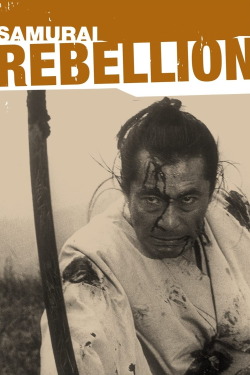
Review of Samurai Rebellion (1967) by Tom B — 10 Mar 2010
A favorite. Not an action film in the least, rather a family drama, and a drama about an individual man, his son, and his son's wife, standing against the pressures of the rest of their family and the full weight of their clan and clan lord.
What I love about this and Kobayashi's Hara Kiri is the way the story is revealed. These are highly sophisticated narratives, and perhaps best credited to Shinobu Hashimoto who also wrote Rashomon.
But in cinematic terms the increase in tension is phenomenal, and I think this is partly achieved by the sharp cutting between scenes, especially flashbacks, and I think this sharp cutting exists in these films because of the samurai elements.
They are like sword cuts, increasing the intensity of the rising action of the narrative. As always, the favorites are great, with some surprises. Mifune portrays a man who I find initially to be somewhat weak, and he's very convincing, and then equally convincing at the end when he becomes strong.
Nakadai plays a noble warrior-type who nevertheless adheres to an ignoble cause. It is these kinds of convolutions specifically that seem to delight the philosophical probings of these two films. If a person is loyal to a cause that promotes disloyalty, is this incongruent? Perhaps, and perhaps not, as in the world of Japanese shogunate ideology.
But this is about the hypocrisy of those ideals. As always, shame is at center of family and social pressure, to shame the family is unforgivable. For this a man and woman are torn apart and misused, love sacrificed to meet the needs of those in power, and spat on by family members who can do nothing better than disapprove and then sever.
It's an age-old theme. The true bright lights are the performances by Go Kato and Yoko Tsukasa, especially Tsukasa who communicates so much without words. Potent and engaging, a real treat for anyone who's never seen a film like this, and for action junkies there's the showdown in the final ten minutes, although it's anything but frivolous.
Action in a Kobayashi film is always meaningful, always tragic, and always satisfying in terms of story. Wonderful filmmaking, great food for thought, and thoroughly engaging human drama.
This review of Samurai Rebellion (1967) was written by Tom B on 10 Mar 2010.
Samurai Rebellion has generally received very positive reviews.
Was this review helpful?