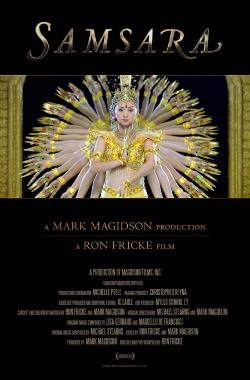
Review of Samsara (2011) by X-Abrupto — 26 Mar 2013
This movie falls in the very select category of non-verbal films. It is not made for everyone. Most movies present a story to the viewer and the viewer has no reflection to make about the storyline until the movie is over.
Samsara gives images to the viewer, but barely reflects a concrete scenario and therefore it demands that the viewer must think and make a personal interpretation of the images. In this sense, it is like a painting.
When you view a painting, and especially abstract ones, you will get your own vibe from it and you might discover that those who saw it might not have had the same conclusion about its message. The same can be said about Samsara, along with the other Ron Fricke movies.
Many people will look down upon those who take the time to interpret a painting and I am not surprised many critics took this movie down. Fricke's work as a cinematographer has been unsurpassed since the mid 80's.
The way he presents his subject is both direct and abstract at the same time. His influence on today's cinema is perhaps one of the biggest unknown fact. Many popular directors of today have seen Fricke's work while studying cinema and took lessons whilst watching his movies.
Fricke is the undisputed master of timelapse for he not only puts his camera in the right place, he also puts it at the right time and finds a way to capture deeply poetic images. I've always considered Fricke to be the heir of Stanley Kubrick in terms of cinematography.
Samsara, however, lacks the athmosphere Kubrick put in his films. Baraka was able to create an obvious athmosphere. So what happened? The problem is, Samsara will often give us images of what we have seen before in Fricke's movies, which make certain scenes look like they have been patched to fill an emptyness that isn't really there in the first place.
It's also a problem that Samsara is clearly "Baraka 2". Even the font used in the title is similar to Baraka's. Baraka, while capturing some images previously seen in Koyaanisqatsi and Chronos, managed to make something original nonetheless, whether it be thanks to editing or great music.
Samsara is too intimately tied to Baraka, which reduce its originality. Lisa Gerrard and Michael Stearns' music sometimes seems to lack the intensity it had in Baraka as well. Overall, the vast majority flaws of this movie reside in the post production, because what Fricke was able to capture all over the world was sincere, breathtaking and inspiring.
I believe Fricke wanted to do certain things in Baraka, but was limited, whether it be because of time, money or other reasons. So he made Samsara in the hopes that he could catch up on what he wanted to do initially.
And he sure could do it with Samsara because he had Baraka's fame behind him. But he overestimated his ability to find originality in an already well used concept. Samsara isn't bad. Far from it. There are scenes that stand out from others.
I especially enjoyed the scene of the man going through various facial transformations, an obvious critique of today's materialistic world and the cult of the image. It was unsettling, vivid and definitely marked some sort of cornerstone within the movie afterwards, it seems Samsara got better and better.
I believe Fricke's next movie will be definitely different from what we have seen so far. Samsara is the extra stuff Fricke wanted to finally get done with and now that he has done it I expect him to undergo an artistic metamorphosis.
My prediction is that Fricke's next movie will contain... Words.
This review of Samsara (2011) was written by X-Abrupto on 26 Mar 2013.
Samsara has generally received very positive reviews.
Was this review helpful?