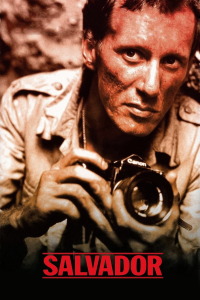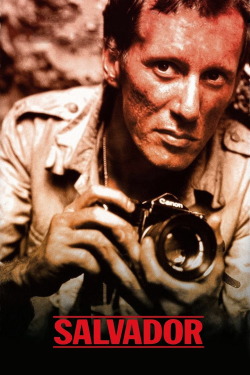
Review of Salvador (1986) by Jim H — 30 Aug 2010
This is how a political drama is done, and it should be no surprise that Oliver Stone is the one to do it. I find it fitting that I watch this immediately after Hunt for Justice (how a political drama is not done). Stone understands that the political facts of El Salvador are less interesting than the human drama that inevitably creates and is affected by state-induced strife. Consequently, we get troubled, but ultimately engaging, characters like Boyle and Doc. And the film's main action has less to do with questions of Communism and Reagan-era, CIA-sponsored Latin American civil wars and more to concern with whether Boyle and Maria are going to live or die, escape or become ensconced in the conflict, love and live together or break up. This contrasts Hunt for Justice, in which there was no such suspense and no such high-stakes concern for the characters' lives. Of course, there is the requisite amount of Stone's political commentary, and much of it is given in Woods's characteristic rapid-fire delivery. Not to mention: if you watch the deleted scenes, you'll get to hear complex political analysis while the characters are getting blow jobs. Who says politics can't be fun?
The film does have flaws. As in JFK, NBK, and Born on the Fourth of July, Stone likes to pound his audience in the head with politically created human suffering. Sometimes it's effective; occasionally, in Salvador, it's overkill (no pun intended (of course, by saying that, I'm drawing attention to the fact that there's a pun (doesn't that imply a pun is intended?))). Also, I thought Boyle's relationship with Maria could have been front-loaded. We see him with an Italian wife at the beginning and various other women before we meet Maria. Even given the confession scene, what's to prevent us from thinking she's just another notch in Boyle's belt?
This review of Salvador (1986) was written by Jim H on 30 Aug 2010.
Salvador has generally received positive reviews.
Was this review helpful?