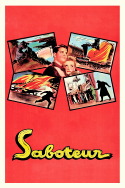
Review of Saboteur (1942) by Edith N — 12 Mar 2009
This was only Hitchcock's fifth American film; he moved to Hollywood in 1939. (The man was certainly prolific!) Being British, he was obviously ahead of the curve when it came to portraying the Nazis as the enemy (though the Nazis are, from what I noticed, never actually mentioned in the film). As I recall, Selznick was, too, though Wikipedia is not helpful on the subject. At the time, Hollywood was touchy about saying bad things about the Nazis, because they were afraid of losing their European markets. However, just before filming began--two weeks before filming began--the Japanese attacked Pearl Harbor. This made Hitchcock one of the first out of the gate with a patriotic film, one showing the war effort and the vile nature of the enemy. Obviously, Hitchcock, if he ever was, was not yet a patriotic American. However, it is a patriotic American film.
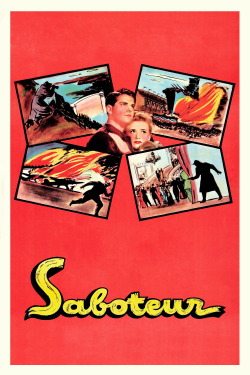
Barry Kane (Robert Cummings) works in an airplane factory, one of the many factories ramping up war production. One day, he and his best friend, Ken Mason (an uncredited Virgil Summers, the film's Best Boy in his only acting role), accidentally bump into Frank Frye (Norman Lloyd), spilling his letters and so forth to the ground. Kane happens to notice the name and address on one of them, but it doesn't really matter. The lot of them sit down to eat in the factory cafeteria, and while they're eating, the cry goes up--the paint room is on fire! Kane, Mason, and Frye go running toward it. Frye hands a fire extinguisher to Kane, who passes it to Mason and goes looking for another one. Before he can, the fire surrounds Mason, and he is killed. It later turns out that the extinguisher is filled with gasoline, and as the one who handed the extinguisher to Mason, Kane is the automatic suspect for being the saboteur. He is then on the run from the police--and the real saboteurs, because he goes to the address on Frye's letter and lets them know that he's on to them. Oh, and of course there's a girl--Pat Martin (Priscilla Lane)--involved.
The plot is kind of silly. For one thing, we never find out if Frye set the fire in the paint room in the first place, or if he somehow managed to fill a fire extinguisher with gasoline and just kind of leave it there in case there was a fire. Even if he set it himself, really? A fire extinguisher full of gasoline? Really? Isn't paint flammable enough on its own? In the famous Statue of Liberty sequence at the end, one man grabs another's sleeve to try to save him. His sleeve? Not his arm? And, of course, Philip Martin (Vaughan Glaser), the old blind man, trusts Kane enough to send his niece along with him, alone in a car together on all-but-deserted roads. It is also awfully easy for Kane and the sabotuers to find one another, even though they're all racing across the country at the time--the story starts in Los Angeles, after all, and ends at the Statue of Liberty.
On the other hand, the story keeps going enough for us to kind of ignore the silliness. As per usual, we have Hitchcock's fascination with the wrongly-accused man. Kane is, we know, innocent. Of course, we know how it will end, not least because this was under the Breen Office. However, despite the limitations placed on him, Hitchcock always managed to inject suspense into his stories anyway. For example, will Kane be able to get across the country fast enough to stop the sabotage planned? Heck, will he be able to figure out what it is? This is all put together well enough to keep us going, in part of course because of Hitchcock's mastery. On the other hand, however, some of the writing was done by Dorothy Parker. So far as I can tell, no one knows exactly what she wrote and what she didn't, but she was a talented enough writer that the script shines despite its silliness.
Hitchcock's cameo here is not very interesting. He's just kind of standing there. This is because the Breen Office did not approve of his original idea. The plan was for Hitchcock and a woman (his secretary, in fact) to be walking down the street, speaking in sign language; they were intended to be deaf-mutes. He was to say something from her in sign language and then get his face slapped. Apparently, the Office didn't think that was a proper representation of the handicapped. They were okay with the train car full of circus freaks, though.
This review of Saboteur (1942) was written by Edith N on 12 Mar 2009.
Saboteur has generally received positive reviews.
Was this review helpful?