Review of Rush (2013) by Clarisesamuels — 17 Feb 2014
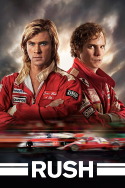
In a voiceover during Rush, we hear the voice of Formula 1 race car champion James Hunt (played by Chris Hemsworth): “I have a theory why women like racing drivers. It's not because they respect what we do, driving round and round in circles. Mostly they think that's pathetic, and they're probably right. It's our closeness to death.” That quote is not only a telling description of the personality of the character of James Hunt, as depicted in the film, but it also describes the absurd philosophy behind the “rush” of race car driving, and probably any other sport that involves mortal danger. It is the thrill that attracts a certain kind of personality to this dangerous sport, and sadly it may also be the thrill that attracts thousands of spectators.
The morbid appeal of a struggle to the death goes back to ancient sacrificial rites and the gladiatorial games of ancient Rome. There is something fascinating about seeing an athlete who stands before the crowds knowing that he must look death in the face and that he may very well lose the battle. It is the misguided sense of valor, courage, and destiny normally reserved for soldiers and knights, who at least are willing to sacrifice themselves for a noble cause—they are ready to die for country, king, faith, and family. Military courage is the stuff of heroes and protectors, but race car driving? Not really.
The 20% mortality rate mentioned in the film may have improved since the 1970's. Apparently safety measures have been stepped up so that race circuits are much safer than they were 10-20 years ago; the Formula 1 design has also been improved for safety, although the open cockpit of the car still presents a danger to the driver, while proposals to cover the cockpit are controversial. Thirty-two Formula 1 drivers have died during a World Championship Grand Prix, the last one being Brazilian driver Ayrton Senna who died in 1994 at the San Marino Grand Prix. The count goes up to 50 if you include drivers who were killed during lesser events (the last death in 2002), and that figure does not include marshals and other bystanders who have been killed on the track.
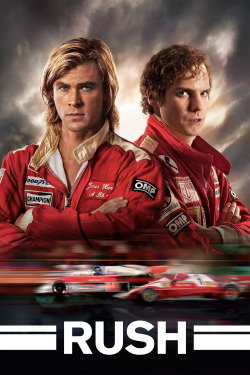
The film tries to delve beneath the obvious reasons that race car drivers are attracted to the sport, which would be an obsession with automobile mechanics and design as well as an obsession with speed. The story revolves around two historic Formula 1 titans—British driver James Hunt (Chris Hemsworth) and Austrian driver Niki Lauda (Daniel Bruhl). Hunt is a dashing hedonist who is addicted to cars, women, cigarettes, and alcohol; Lauda is by contrast a stoic, who is quiet, dedicated, and believes that true success lies in the strictest form of discipline. If Hunt is a playboy, Lauda is a monk (although Lauda says he was not as strict as depicted in the film.) They are both attracted to the sport but come armed with completely opposing philosophies. For Hunt, the racetrack is a forum for attention, celebrity and the sensual experience of life; it is his temple for living in the moment and seizing the day. For Lauda, the racetrack is a different kind of temple, one that demands an almost religious reverence and meditation, and where he connects to the deepest part of his soul. The two men are both rivals and friends, and the film doesn't mention that in real life they were once roommates.
Ron Howard's film sets out not just to dramatize a significant race year in the lives of both drivers, but to show how the two differing philosophies affected them both on and off the track. Lauda suffered devastating burn injuries to his face and lungs in a Grand Prix accident of 1976, which caused him to be disfigured for life. He went into a coma and almost died after that race, but then he mustered up the intense will and discipline for which he was known, and he climbed back into his Formula 1 Ferrari just six weeks after the accident, which was nothing short of a miracle. James Hunt achieved his dream of becoming a Grand Prix champion that same year, and a few years later left the sport to become a commentator. Hunt, a heavy drinker and smoker, died of a heart attack at the age of 45.
In another voiceover, this time by the character of Niki Lauda, who in real life won three Grand Prix championships and is now 64 and retired, we hear these words as he speaks of the race that changed him forever: “The other thing I'm remembered for is what happened on August 1, 1976, when I was chasing him [Hunt] like an a**hole.” And that line, perhaps better than anything else, aptly describes the philosophical absurdism of car racing.
This review of Rush (2013) was written by Clarisesamuels on 17 Feb 2014.
Rush has generally received very positive reviews.
Was this review helpful?