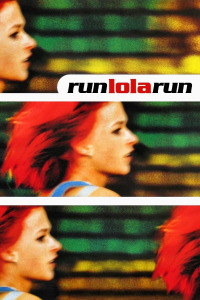
Review of Run Lola Run (1998) by Matt H — 27 Jul 2009
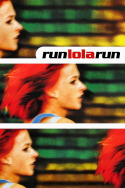
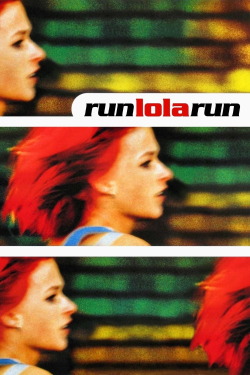
Lola Rennt (Run Lola Run) is my second German movie, after Das Experiment. The plot is simple: a redhead named Lola has 20 minutes to save her boyfriend, Manni, from the clutches of his ruthless mobster boss, Ronnie. Manni carelessly forgets his boss's loot bag in the train, containing 100,000 marks (about $60,000). Lola has to come up with a plan to solicit 100,000 marks before Manni meets up with his boss.
To justify his carelessness, Manni blames Lola for what happened. "Everything was on time except for you. You weren't there... You said, 'Love can do everything.' So find 100,000 marks in 20 minutes." This first encounter with Manni and Lola is significant in establishing their characters. The scene takes about 5 mintues, and you see a couple willing to stick with each other no matter what. Believe it or not, Lola Rennt is a love story.
The movie lives up to its title - Run Lola Run. If you're familiar with Margaret Atwood's Happy Endings (short fiction) and Akira Kurosawa's Rashomon (movie), then you'll have an idea of what this film is like. Lola Rennt is made up of three "running" sequences, each representing a different variation of the plot. So, if you think about it, the basic plot really runs for 20 minutes, coinciding with Manni's lines and the last three statements of the quotation above.
For every level of the film, a different aesthetic is used. It makes use of black and white shots for flashbacks, handheld video for more recent flashbacks (if such a term exists), animation to signal the start of a new plot variation, still pictures for flashforwards (that also vary depending on the plot variation), and the usual 3mm for normal shots.
Aside from these, the film also makes use of what may be called 'red' sequences. The red lighting used in these sequences gives it a dream-like effect. The red sequences are the heart of the movie. Red plays a significant role in the film. Obviously, the color represents passion, that which fuels Lola's burst of energy (her screams and running sequences) to be with, if not save, Manni in times of adversity. She runs because of love, not away from it.
There are other notable things about the film. First, the soundtrack used in the film is very apt for each sequence. Second, there is the recurring image of the clock, reminding viewers of the conflict. Third, the plot variation gives viewers a glimpse of the wide array of possibilities that could take place, depending on Lola's encounters. I had a good laugh with the ending.
If you wish to see something different, something simple and complicated at the same time, watch this film.
This review of Run Lola Run (1998) was written by Matt H on 27 Jul 2009.
Run Lola Run has generally received very positive reviews.
Was this review helpful?