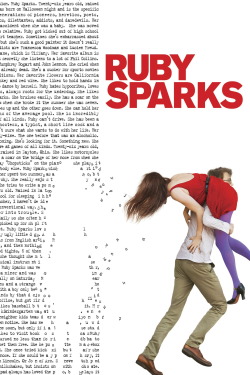
Review of Ruby Sparks (2012) by Spangle — 16 Aug 2017
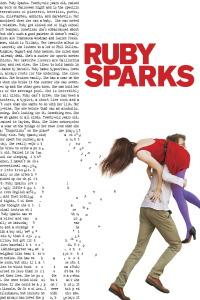
First defined in a review of Cameron Crowe's Elizabethtown, the concept of the Manic Pixie Dream Girl stock character - a mystical girl who lives solely in the mind of young romantic male writers that exists solely to provide happiness for the male lead with no apparent life of her own - is one that is tried and true. Following its definition, critics scoured film history to find additional Manic Pixie Dream Girls in film that met the criteria laid out by Nathan Rabin. As with any stock character, reliance upon the Manic Pixie Dream Girl in romantic comedies quickly became derided for their unrealistic portrayals of women, the lack of knowledge on the part of the writer on how to write a woman, and simply lazy reliance upon a stock character. With famed novelist Calvin Wear-Fields (Paul Dano) writing a novel about a girl he dreamed about that he names Ruby Sparks (Zoe Kazan) only for her to come to life, the film Ruby Sparks stands as a direct criticism of the Manic Pixie Dream Girl stock character and the truly dark implications bubbling under the surface.
Starting off incredibly cute, as with any romantic comedy, Calvin is shocked to see women's clothes in his home after a long night fleshing out her character and starting his novel. Not long after, Ruby pops up in his kitchen one morning, exactly as he described. With each word Calvin writes, Ruby changes. If he wants her to be sad, she is sad. If he wants her to be happy, she is filled with "effervescent joy". At the mercy of how Calvin writes her, Ruby is the epitome of a Manic Pixie Dream Girl. Unaware of her own roots, Ruby begins to grow tired of Calvin due to his self-loathing nature and refusal to recognize her needs, always choosing to satisfy his own. Once she begins to express this sentience, it is back to the typewriter for Calvin to correct this issue.
Becoming rather chilling at this point, we see to the degree that it harms Ruby to have Calvin constantly changing her demeanor or mood. She has no ideas or abilities that are not given to her by Calvin and it is the kind of absolute, perverse control that male writers often exhibit when writing Manic Pixie Dream Girls. As Calvin's brother Harry (Chris Messina) suggests, Calvin needs to take advantage of this. Constant sex, bigger **** longer legs, and more are a necessity. It is naturally superficial and hints at the perverse and toxic masculinity that is the target of husband-wife writing/directing duo Jonathan Dayton and Valerie Faris' work in this film. In the chilling, horror-esque sequence in which Calvin frantically re-writes Ruby as she stands in front of him, forcing her to strip, dance, speak French, and more, the film brings it all too light. What starts off as a sunny, cheery, and undeniably cute and charming romantic comedy rapidly becomes a chilling hyperbolic example of Manic Pixie Dream Girls in cinema. It is not cute to watch some one-dimensional female character race around after a guy and change on his whim throughout the film. In fact, it is both damaging to women in general and to men, who come to believe that women are truly like this in real life. There is no woman like a Manic Pixie Dream Girl and Harry consistently reminds Calvin of this fact. Women are not some mystical creature, as far too many male writers imagine them to be. They are just people. Angry, sad, happy, and loaded with nuance, women just are. There is no "getting" or whatever films often speak about in regards to women. They are just people with lives, hopes, and dreams, like anybody else. As such, in the film, Calvin's desperate re-writing and regrets with Ruby are derived from moments where she begins to stray from him and show sentience. Not only does he fatefully lack understanding of women at all, but he doubles down and seeks to control them. Vengeful, wicked, and sick with power, Calvin ominously warns Ruby that he can control her before he does so, which only serves to worsen the relationship. No longer natural or filled with the proper anxieties, joy, or sadness, the romance feels rather sinister with Ruby only there to please Calvin exactly how he desires. She is his puppet, subject to his every whim no matter what and only existing to provide him the satisfaction of having a girlfriend, not forming an emotional bond with them. It is possessive, horrifying, and yet brilliant. While the film as a whole has some issues that do not make it work nearly as well as it can - never quite as funny as it could be and too often embodying the works it is critiquing by trying to pass off the romance as romantic initially - it nonetheless smartly shows the end result of Manic Pixie Dream Girls in cinema. Derived from a place of loneliness for writers, it leads to unrealistic expectations in men who then try to manipulate and construct women out of the "ideal". For women, they seek to conform and only wind up losing themselves in the process, becoming unsure of who they are without him.
This review of Ruby Sparks (2012) was written by Spangle on 16 Aug 2017.
Ruby Sparks has generally received positive reviews.
Was this review helpful?