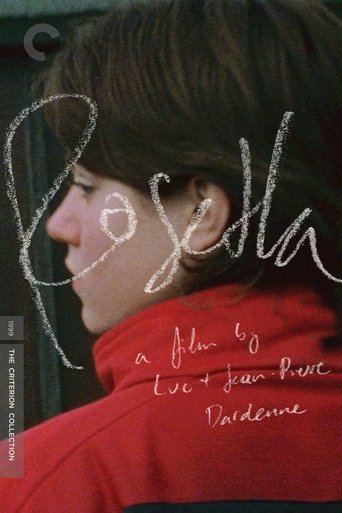
Review of Rosetta (1999) by Andhika B — 22 Feb 2010
It's not easy to make a film 100% "realistic", the cinematography can't be too flash, there can't be too much makeup on any of the actors (who can't suddenly blurt out monologues from Shakespeare and make exaggerated hand gestures), each location has to look like it was never touched by an art/set decorator and there can't be any expositionary dialogue. While it may not be 100% realistic, The Dardenne brothers' "Rosetta" gets pretty close to being completely realistic and is also a very good film, capturing the story of a teenage girl looking for a "normal life".
The titular heroine just got fired from her factory job and is taking it so badly that the Police are called in to make her leave. As she walks back home, we see her go fishing in a lake, meet her friend Riquet who works at a waffle stand and we get a glimpse of the trailer home she shares with her recovering alcoholic mother (we never hear about the father, but a couple men do visit the mother when she's drunk). Rosetta's idea of a "normal life" revolves around getting a steady job, pestering every shop and factory owner into hiring her, but some bad timing prevents her from keeping a job in a bakery, forcing her to take drastic measures to realise her dream of getting enough money to leave poverty behind for good. She also receives stomach pains every once in a while adding to her struggle.
Rosetta is a proud + determined teenager, and the Dardenne Brothers track her every movement with only one camera, nearly always staying within 2 metres of her as we follow her through an unnamed Belgian town. The camerawork may be jerky at times, but it only adds to the realism of the story and the camera movement never pre-empts where Rosetta will go, it merely reacts to her movements so faithfully the whole film feels like a documentary at times. It also helps that there is no soundtrack during the film and Emilie Dequenne puts in a very natural performance which earned her a Best Actress award at Cannes.
This may be a sad story of one girl's struggle to escape poverty, but the Dardenne Brothers never go for an easy tearjerking moment, preferring to examine their subject with a near-suffocating intensity in order to plot Rosetta's change in moods and emotional growth. It effortlessly echoes the neo-realism of Vittorio De Sica without a hint of melodrama, adjusting itself to the rhythm of Rosetta's daily routine right up until the poignantly abrupt ending, where the audience and Rosetta realise that while the dream of a secure future may be unattainable for now, keeping your humanity will see you on the path towards that secure future. By asking for empathy instead of sympathy, the Dardenne Brothers were rewarded with the Palme D'or in 1999 for "Rosetta".
This review of Rosetta (1999) was written by Andhika B on 22 Feb 2010.
Rosetta has generally received very positive reviews.
Was this review helpful?