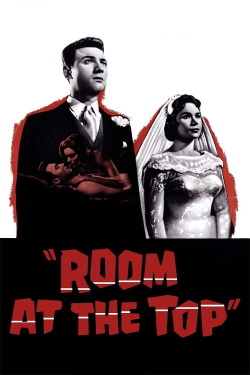
Review of Room at the Top (1958) by Eliza F — 07 Mar 2012
Joe is a bit of a bastard. Clearly ambitious from the get go. He's already made steps beyond his British working class into city office job. But he wants more. He sees a future where he "owns the lot". This is among the first of the British New Wave films and other than "A Hard Day's Night", it's the only one I've seen. Like the French New Wave that was occurring simultaneously, the effect of WWII led filmmakers to make a more realistic style of film. So back to Joe. Like I said, working class. He fought for the freedom of his country like everyone else. Lost his family and his home. So his attitude is a sense of entitlement against the aristocratic people he mixes with.
He sets his sights on the pretty girl getting in the expensive car. His lust extends not as much to her as a being, but as an antique possession. Best of all, she's the millionaire's daughter. But he plants the seeds that impressionable young girls grow to elms. He becomes the pariah of her parents which even he acknowledges as a breakthrough. While he bides his time, he takes time with an unhappily married French actress 10-years his senior. His conflict is ultimately the audience's. Is his time with the Mrs. his true nature, or is he selfishly maneuvering to the next ladder rung?
The performance of the Frenchy, Simone Signoret was the highlight and she indeed took the Oscar home. She's dark and tragic, even in her optimism. That's true of the film altogether. While this New Wave "Angry Young Man" scene had principle, it also focused on the failures of these British men and class system that they fought through. This is a great example of that sociology and the struggle is felt to the very last scene. "Darling, you're crying.".
This review of Room at the Top (1958) was written by Eliza F on 07 Mar 2012.
Room at the Top has generally received very positive reviews.
Was this review helpful?