Review of Roger & Me (1989) by Peter N — 14 Feb 2008
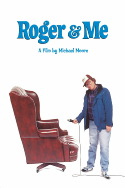
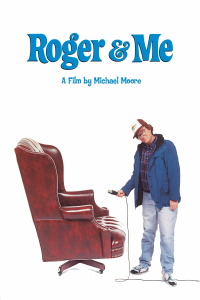
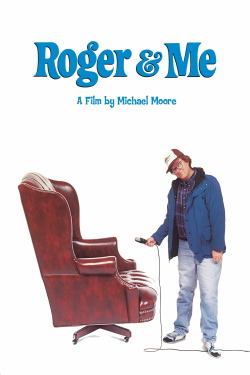
Although humorous and entertaining, one can understand why critics such as Pauline Kael and Harlan Jacobson have a problem with Michael Moore's approach to documentary filmmaking. Indeed, from the audience's perspective, almost everyone Moore interacts with in Roger & Me looks callous, short-sighted, or inane through his lens; albeit for good reason. In addition, once viewers become conscious of Moore's domineering edit techniques and chronological laxity, they may write off the valid arguments he does make. But if Moore strictly adhered to documentary ethics, would Roger & Me still have been the most successful documentary of its time? While there is no clean cut rebuttal to Moore's critics, each argument must be examined case by case, gauging their contextual validity.
Perhaps the most piercing evidence of Moore's manipulation is his decision to omit the dialogue between him and Roger Smith during the 1987 GM shareholders meeting. This point, in particular, is so pivotal because the film is driven by Moore's quest to speak with Roger Smith. Moore could have easily not attended the meeting and therefore not even mention it. This quandary alone realizes Moore's ability to direct the story as he pleases. As the scene unfolds in the film, Roger Smith appears to be ignoring Moore's presence despite Moore's plea for questions. Here, Moore shows conscious manipulation of an event; an indisputable example that he crossed the line. Problematic scenes on this order of magnitude can completely shatter the viewer's trust in Moore as a documentary filmmaker and what we see on screen. Jacobsen explains, "[Roger & Me] has the form of documentary...we expect that what we are seeing there happened, in the way in which it happened, in the way in which we are told it happened.".
On the other hand, one problem Moore's critics are overlooking is that they are lumping Roger & Me into the largely diverse and loosely defined genre known as "the documentary," as if all films showing real footage of real people and events should be held to the same standards. Roger & Me is a hodgepodge of Bill Nichol's documentary modes beginning with the participatory where Moore comments on his personal upbringing and explains how he became involved in filmmaking. Most of Roger & Me progresses in participatory mode, however there are brief jaunts of expository mode where Moore recaps a series of events in "voice of God" narrative. The film climaxes in poetic mode with a carefully choreographed juxtaposition of Smith's warm Christmas message of giving against the harsh images and sounds of a family being evicted; eliciting a contradictory response to Smith's speech. If we also include Moore's style of slight manipulation, what typology of documentary is this?
Like fiction films, the documentary genre has become increasingly more complex and experimental; blurring the boundaries of its classification. Moore may have created a new sub-genre of documentary: one that combines Nichol's documentary modes in a heuristic visual essay where accurate historical representation is eclipsed by unbridled personal emotion. Interestingly, Moore calls Roger & Me "an entertaining movie that hopefully will get people to think a little bit about what is going on". If his intention is to galvanize the public, then does the end justify the means? Does the fact that Roger & Me became the all time best selling documentary upon its release, exposing millions of people to important social issues through the powerful medium of film, justify the bending of truth in his films? In retrospect, I agree with minor stipulation. Is it ok that Moore ambushes people who have no idea of his agenda? In response to Pauline Kael's article, I have no grievance with Moore's ambush interview technique towards people on the street or corporate PR representatives. Kael questions "what does Moore expect?" I doubt Moore expects an insightful and well articulated response from everyone he speaks to. However, Moore's strategy is effective at probing the collective consciousness of America for us to ponder. All too often companies are given ample prep time to strategize a self-serving spin to public inquiry. Moore's approach, in effect, catches them with their pants down. In response to Moore's truth bending, although I disagree with Moore, perhaps he believed it was the only way to reach a broad audience when traditional documentary films and grassroots newpapers were dwarfed by Hollywood blockbusters and mainstream media.
I am still somewhat at a loss in that I admire and respect Michael Moore for what he has achieved. Moore provides a voice for those in the lower rungs of our hierarchal society--he is confrontational, he probes routine corporate operations, he reminds us not to become too complacent in our daily lives. Still, some of his tactics are completely unethical and imposing. I believe Moore has the ability to make entertaining and socially introspective films without the problems mentioned. Whatever you call his films, one cannot deny that galvanizing public interest on social issues is a bad thing for America.
This review of Roger & Me (1989) was written by Peter N on 14 Feb 2008.
Roger & Me has generally received positive reviews.
Was this review helpful?