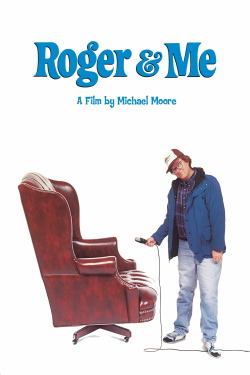
Review of Roger & Me (1989) by Adella L — 01 Nov 2013
Roger and Me - The Movie Review.
By Adella Lee.
Back in 1989, when General Motors CEO, Roger Smith, decided to close several auto plants in Flint, Michigan, it cost 30,000 people their jobs and led to the decline of the city of Flint. Michael Moore was determined to find out the reason why the company closed the plant by interviewing Smith face-to-face. Therefore, he produced a documentary that recorded the entire process of trying to make contact with Roger, which he titled Roger and Me.
In Roger & Me, Moore provides contrast between how wonderful Flint used to be and how horrible Flint is after the plant shutdowns. At the beginning of the documentary, the director shows us how prosperous the city of Flint was in 1989. The documentary depicts the city as a place with a large number of factories and workers, where "every day was a great day." From the perspective of depicting a happy, lively atmosphere, the cinematography, editing and sounds make great contributions. As we can see, most of the shots consist of short takes that illustrate an urgent and fast pace of scenes that indicate prosperity and energetic life of old Flint. The short takes effectively present the colorful and busy daily life of Flint. We can see the busy transportation in the city, numerous people entering the factory, cars being produced in the plant, and car models proudly posing for the camera in front of newest car. Also, combining the short takes with cuts, the documentary effectively reproduces the grand scene of a parade. In less than two minutes, we see well-known individuals such as the GM president and Miss America, a number of large marching bands in the parade, and crowds of spectators along the street celebrating this biggest event: a scene that shows only enjoyment, no worries. Furthermore, thanks to the medium long camera, we can see the happy faces of the on-lookers, probably residents and workers of the city. Lastly, in these scenes, the brisk non-diegetic background music enhances the atmosphere of happiness. It seems like Flint was the most thriving area of the United States, and the residents of Flint lived a happy, carefree life.
After the shutdown of the GM plants, however, all the good days in Flint became a thing of the past, and Flint deteriorated rapidly. By presenting the suffering and struggling of the residents, the documentary utilizes cuts. Through these cuts, we see people being evicted from their houses because they could not afford their house payments or rent and selling their blood to earn a living. Furthermore, while the non-diegetic sounds that come from the news saying that Flint has the highest violent crime in the country, several cuts show people dead in the street, in their houses inside the city, and even in the countryside, which powerfully uncover the cruel actuality of the circumstances of the city and its surroundings.
Confronting the huge changes, Moore, a resident of Flint, felt obliged to do something. He decides to head to the world headquarters of General Motors and talk to the chairman, Smith. He wants Smith to witness the misery in Flint. In the two times Moore attempted to find Smith in the headquarters, framing helps significantly to present what Moore encountered and relays his feelings to the audience. As the camera tracks Moore entering the building and entering the elevator, the audience feels like following him in the scenes. In addition, because most non-conversational scenes were shot from behind Moore, the audience is put on the side of Moore. Therefore, when the worker comes up to speak with Moore and keeps rejecting his request to go up to see Smith, or the security officer talks to Moore but leaves halfway through the conversation, we have the same feeling of being underestimated as Moore has. During the conversations, which are filmed at a medium camera distance, we can see the contrast between Moore and the workers. In these scenes, Moore holds his hands in front of his stomach, which shows his angst, while the workers are putting their hands in their pants' pockets, indicating their indifference. It's hard to not take pity on Moore. People who are penniless and powerless always have difficulty getting the attention of the bigwigs. In most circumstances, they will be treated as Moore is. Even though Moore has written and called General Motors for a whole year after his first rejection, he still ends up rejected. The bigwigs' indifference to the struggling people is revealed by the framing. They care about nothing but the interests of the company.
Through these scenes, Moore tries to illustrate that an irresponsible decision of the company can destroy not just a family but even a city and severely criticize the indifference of the people. It's not hard to find that all the people he encounters throughout the movie as he tries to contact Roger Smith are awfully indifference. They obey the rules with no humanity and care only when something concerns their interests, such as the secretary who rejects Moore after knowing the efforts Moore has made, or the heartless police officer who expels the family from their house on the day before Christmas for the reason that he doesn't want to work during Christmas holiday. The members of the upper class keep saying people should not focus on misery but on happiness; they refuse to realize how much the people of Flint are struggling because they have everything they need, like the people in the Great Gatsby who dare to suggest people in Flint play hockey instead of drowning in sorrow. However, in the meantime, as I mentioned before, the reality is that numerous people of Flint are dying. The misery of Flint and the indifference of the people reveals the dark side of humanity, which powerfully strike the audience heart.
From my perspective, Roger & Me is indeed a first class documentary. After watching the whole movie, it keeps me pondering about how dark this society is and evokes feelings of responsibility for the society. Also, as the documentary is shot from the view of normal citizens, the scenes and feelings are accessible and real. Moreover, as the movie provides a clear position, which stands for the people in the bottom of society, I can see the reality of the poor, which reminds me of I should never forget to care about others when concerning interest. Nevertheless, the technique of the movie is excellent. It uses music to smooth the sad mood of the movie so as to make audiences comfortable while pondering the misery. And it perfectly combines the cinematography and editing to makes scene has its own conflicts and stress, making the audiences feel not bored at all to watch it. I would like to recommend this movie for those who are interested in knowing the reality of society but still want fun.
This review of Roger & Me (1989) was written by Adella L on 01 Nov 2013.
Roger & Me has generally received positive reviews.
Was this review helpful?