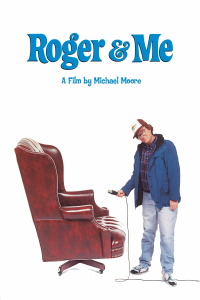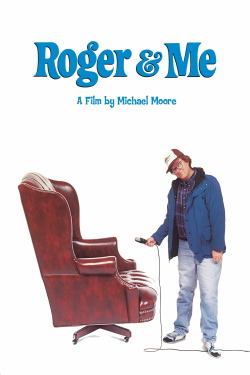
Review of Roger & Me (1989) by David A — 29 Oct 2013
The Economic Tragedy in Flint.
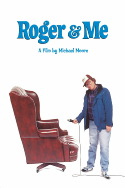
Roger and me is a documentary shot in the 1980's in Flint, Michigan, the birth place of General Motors. The main stars of this movie, as indicated by the name, are the director, Michael Moore and General Motors chairman at the time, Roger Smith. It is a participatory mode documentary and this is why we see the director, Michael Moore, being a main star of the movie. It is a participatory mode because the director, Michael Moore, is actively involved in the movie and he makes his presence known to the audience throughout the movie. Throughout this movie, Michael Moore combines various aspects of cinematic style such as mise-en-scene and editing, to depict the insensitivity of the upper class personalities in Flint and General Motors to the tribulations of the lower class individuals in Flint.
This documentary shows the aftermath of the shutdown of several General Motors plant employing thousands of factory workers in Flint, Michigan. Michael Moore, who is from Flint, Michigan, sets out on a journey across the country to find General Motor's chairman, Roger Smith, and convince him to spend a day with him in Flint, Michigan in hopes that he might change his mind about the plants' shutdown.
The impacts that the plants' shut down had on Flint were devastating. Many people were left unemployed and the standard of living in Flint, Michigan was going downhill. In several scenes throughout the movie, people were getting thrown out of their homes due to unpaid rents as a result of the high unemployment rate in the city caused by the plants' shutdown. In another scene, the local news reported the rat population in Flint, Michigan had surpassed the human population by 50,000 due to people deserting the city and reduction in garbage collection as a result of budget constraints. Lots of people abandoned the city, moving out of the state in search of better living conditions. Later on in the movie, Flint was declared the worst city the live in by Money magazine. All these scenes emphasize the economic turmoil Flint, Michigan fell into as a result of the shutdown of the plants of General motors in the 1980's.
Throughout this documentary, Michael Moore uses mise-en-scene-sets and props and costumes-to emphasize the inconsiderate nature of the upper class individuals towards the troubles that the lower class individuals were facing. He uses various elements of mise-en-scene, such as sets and props and costumes, in several scenes throughout the movie to convince the viewers about the contrast between the situations of the upper class and lower class individuals. This contrast helps Michael Moore portray the insensitive nature of these upper class individuals. For instance in a scene earlier on in the movie, Michael Moore uses mise-en-scene effectively to display the inconsiderate nature of these upper class individuals at the annual Great Gatsby party, which was held in the home of one of General Motors' founding families at the same time that the General Motors' plants were shutting down. In this scene, the sets and props included the Polo player's horse riding during the party and playing polo, the exquisite dishes served in a buffet-style format and the human statues dressed in tuxedoes and formal gowns. The costumes in this scene, included tuxedoes, bowties, dressing gowns and other expensive dresses worn by the guests at the party. The Mise-en-scene (sets and props and costumes) of this scene shows the extravagant display of opulence by upper class individuals of Flint and one of the General Motors' founding families at the party at a time of economic downturn in Flint, in which thousands of factory workers had been laid off. Michael Moore uses mise-en-scene in this scene, as in other scenes, to emphasize the insensitivity of the upper class individuals-the family and the guests-to the quandary that the local factory workers who had just lost their jobs were in.
Michael Moore also uses editing throughout the movie to portray the insensitivity of upper class individuals in Flint and General Motors towards the tribulations that the lower class people were facing. He uses editing to show the sharp contrast between the situation of the upper class and that of the lower class and uses this effectively to expose the insensitive upper class individuals. For instance in one scene later on in the movie, Michael Moore uses the editing convention called cross-cutting, as he alternates between scenes of Roger Smith giving a Christmas speech at the traditional General motors Christmas program in Detroit, Michigan and of an African American family getting evicted from their home in Flint, Michigan. Michael Moore uses this editing convention effectively in this scenario as he emphasizes the incongruity between Roger Smith's Christmas message and the reality that the unemployed factory workers in Flint, Michigan were facing. For example in one scene Roger Smith quotes Charles Dickens saying "I have always thought of Christmas as a good time" and immediately Michael Moore cuts to a scene of the African American woman scolding her daughter to put on her clothes as they were being evicted from their home. Michael Moore effectively showed the irony of this situation through editing to emphasize the insensitivity of the upper class individuals such as Roger Smith to the hardships that the local people of Flint, Michigan have to face as a result of the economic decline just like he had done in previous scenes throughout the movie.
The director, Michael Moore, shows that the shutdown of General Motors' plants by Roger Smith was a wrong move and aside from leading to the unemployment of thousands of factory workers, this decision had greater negative impacts on Flint, Michigan. Michael Moore shows these negative impacts in several scenes throughout the movie, such as increase in crime rate, decrease in the standard of living, and decrease in the human population of Flint as more and more people began to desert the city. The situation in Flint sparked Michael Moore to set out on a journey across the country to look for Roger Smith and convince him to spend a day at Flint, with the aim of changing his mind concerning the plants' shutdown. Within this journey, Michael Moore shows the insensitivity of the upper class individuals in Flint and General Motors towards the struggles of the lower class people in Flint.
There are also certain values that we, as the audience members, can pick from this documentary. For instance throughout the movie, Michael Moore demonstrates his strong determination and tenacity by refusing to give up on his mission to bring Roger Smith to Flint, Michigan. Despite the several obstacles we see him encounter throughout the movie, such as being asked to leave a private social club he suspected Roger Smith was going to visit or being asked to leave the General motors headquarters twice after trying to use the elevator without authorization, Michael Moore refused to give up and pushed on in his quest to find Roger Smith.
Another value that we can pick from this documentary is the caring heart of Michael Moore which I find very admirable. As we know from the documentary, Michael Moore was not a factory worker for General Motors and in fact he was a newspaper editor in San Francisco, California, and had just lost his job for trying to dedicate a monthly column to a Flint Auto worker. In other words, he was not affected directly by the General Motors plants' shutdown, however, he had the initiative to seek after Roger Smith to try and bring a change to the situation in his society. Very few people who aren't directly affected by a situation like the one in Flint would take it upon themselves to bring about a solution to situation and because of this I find Michael Moore a very respectable man indeed.
I believe this film is a spectacle and the way Michael Moore combines various cinematic styles such as mise-en-scene and editing to convey his opinions throughout the movie was phenomenal. From using voice-over commentary to put in a little bit of sarcasm in some scenes to using editing conventions such as cross-cutting to show incongruity and emphasize his views in other scenes, Michael Moore is successful in evoking empathy from the audience towards the local people of Flint, Michigan. Personally, I am moved by the struggles of the local people in Flint, Michigan because in my country, Nigeria, the rich people are constantly oppressing the poor people and this breaks my heart to see how helpless the lower class individuals are in such situations. Also, knowing that these upper class individuals have the ability to change the situation of the lower class people in the society but choose to remain silent concerning it is even more frustrating to me. In conclusion, this movie is a must see movie that has all the interesting and fascinating elements a movie viewer looks for.
This review of Roger & Me (1989) was written by David A on 29 Oct 2013.
Roger & Me has generally received positive reviews.
Was this review helpful?