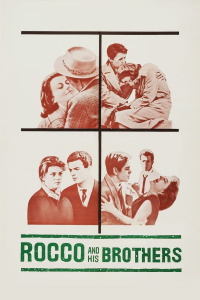
Review of Rocco and His Brothers (1960) by Lewis P — 23 Jan 2011
Excellent acting but tale of misguided filial obligation doesn't ring true.
*** This review may contain spoilers ***.
'Rocco and his Brothers' begins as the Parondi clan move from their rustic life in Lucania, in the southern part of Italy, to the bustling northern metropolis of Milan. Head of the clan is the mother, Rosaria, a loud, obnoxious woman who can be best described as a worry wart. She brings her four sons, Rocco and Simone (in their early 20s), Ciro, a teenager, and Luca (about eight), to visit Vincenzo, the older brother who is engaged to Ginetta (played by Claudia Cardinale before she became famous). The expectation is that Vincenzo has arranged for his in-laws to put his mother and siblings up until they can obtain permanent lodging. Unfortunately, Rosaria and Ginetta's mother don't get along and Vincenzo is forced to find other quarters for them. Vincenzo consults a maintenance man who advises him that the family can move into an expensive apartment, stop paying the rent after a month and have the City of Milan then put them into decent housing since anyone who has officially been evicted, must be provided with social services by the City.
'Rocco' is divided into five segments, focusing on each of the brothers. The first segment involves Vincenzo whose character appears in stark contrast to his younger siblings. Whereas the newly arrived Parondi's are very unsophisticated (they've never seen snow before) and regarded as country bumpkins by the residents of Milan, Vincenzo is a virtual cosmopolitan. While he has a small part in the film, Vincenzo serves two important purposes: 1) He is held up as less stable than the the younger and more together domestic pillar, Ciro, in that he is never able to facilitate a reconciliation between his mother and in-laws and ends up marrying Ginetta, more out of obligation than complete love, after she accidentally becomes pregnant; and 2) He ends up bumping into Nadia, the prostitute, in the hallway of the family's apartment building, introducing her to his other brothers.
The next segment focuses on Simone who is the film's evil antagonist. All good melodramas need a good villain and Simone fits the bill to a tee. He dates Nadia for only a short time before she becomes sick of him; despite dumping him, in Simone's mind, Nadia has become his possession. Despite his professed love for Nadia, Simone has no guilt feelings about seducing the cleaning store manager where Rocco works. This is after he borrows (without permission) an expensive shirt from the cleaners to go on his date with Nadia. What's more he steals a broach from the store manager and gives it to Nadia as a gift; only to have it returned by Nadia to Rocco with a message to Simone that she doesn't want to see him ever again. For a short time, Simone has some success as a local boxer but soon falls from grace.
The next segment focuses on Rocco who can best be described as an 'enabler'. At the end of the film, Ciro describes Rocco as a 'saint' but criticizes him for forgiving everyone for their transgressions. Rocco's character is the linchpin of the film and he's not a convincing character at all. At first, he wants nothing to do with boxing as he regards it as sleazy. Rocco eventually wants to return to the South where his kind-hearted nature might flourish. After joining the Army, he runs into Nadia and they develop a hot and heavy relationship. This leads to the most dramatic moment in the film, when Simone rapes Nadia in front of Rocco out of jealousy and Rocco in turn orders Nadia to 'go back' to Simone out of some kind of misguided filial obligation. If you believe anyone would have been so attached to his brother after spending so much time trying to show a downtrodden prostitute a new life (and actually ending up transforming her), then perhaps I can sell you the Brooklyn Bridge. I know it's supposed to be an example of a 'family tragedy', but I just don't believe anyone would have done such a thing, especially after he's a direct witness to his girlfriend being raped. Equally unbelievable is the subsequent scene where Nadia is about to spit in Simone's face and tells him she'll never go back to him--and then ends up kissing him and agrees to be his concubine.
The next to last segment focuses on Ciro who is held up as the only well-adjusted brother in the clan. He is in effect, Rocco's better half. After Simone steals thousands of dollars from his former manager, Rocco (now a successful boxer himself), has his manager guarantee money to pay Simone's debts in exchange for a contract which will obligate him to fight for another 10 years. After Simone kills Nadia, Rocco keeps playing the part of the enabler by insisting that everyone in the family keep quiet. But Ciro wisely informs the police who pick Simone up for Nadia's murder. Ciro serves to restore order to the out of kilter Parondi clan. It's Ciro who also wisely tells Luca, in the final segment, that even returning to the south, the supposed fount of innocence, is not a panacea to life's problems since things are constantly changing and no one can predict the outcome of what life has in store for us.
'Rocco and his Brothers' is very well-acted coupled with excellent cinematography. It should have all the ingredients of a masterpiece but doesn't. That's because its main character is not believable. Sure there are plenty of people like Rocco who would bail their brothers out financially even with the knowledge they had done something wrong; but to order their true love back into a destructive relationship with their brother after he just raped her, that's something I couldn't believe.
One sad addendum: Annie Giardot (Nadia) who was married to Renato Salvatori (Simone) in real life, is still alive but has Alzheimer's and has no memory of her former life.
This review of Rocco and His Brothers (1960) was written by Lewis P on 23 Jan 2011.
Rocco and His Brothers has generally received very positive reviews.
Was this review helpful?